The Pendulum

January 25th, 2011

Thursday was a seesaw of a day. It swung from one end of the spectrum to the other. No matter which end you were on, you couldn’t help but feel the breath of something so much bigger.

Jorn, the man in charge of Ranger Safari’s fleet said one set of parting words to me as I drove off in Miss Tembo. He said,” I’ll be hearing from you tomorrow. There is always something wrong with the car on your first day out.”  He did not mean to say I was a pain or a complainer but still I wagged my finger at him in jest. He replied that it was fine because this was the only way we got to talk to each other.

The following morning, I was ready to go, we were loading into the car, bags were packed, cooler filled with ice for water samples, paper work ready for school assessments, my big binder in place to lift me off the seat so that my feet could reach the petals, and Boom!

Starter turns over, turns over again, then – makes the saddest sound and then silence.

Nothing.

“You are kidding me!” I yelled. “Today, of all days!” At this point it is three days before I have to leave and the western connection to time and this idea that it is running out, was making its way into my consciousness.

I called Jorn and blamed him. I told him that he cursed me and he laughed his deep, big, hearty red headed laugh.

He said he would have a mechanic to me in about an hour. I needed to be in Mbuguni in an hour and we had other schools we needed to assess on the way.

I sat down in the dirt in the parking lot, on the brink of allowing this incident to choke the enthusiasm out of me.

A voice in my head cried, “No! Get up!”

I listened and went back into the front desk to ask for the keys to Remtula. Remtula is the name of the house Abbas was prepared to rent to us. I figured I could use the time to see if it was a match for our office needs. I also assumed I could walk there.

“It is far.” Glory said, a beautiful woman who works at the hotel.

“Far?” I replied – I thought it was just around the corner from the farm house.

“Not so much.” She said.

I paused and vacillated back to the solar panel idea at Anna and Joseph’s house. Right at that moment, Anna called and was returning from the market with the food for the men at Manyatta. The taxi driver was unloading the food. I figured the meter was running – not really, there are no meters in this part of the world – so why not use the time to go and check out Remtula.

Remtula was nothing that I had expected it to be. I actually felt a lot of peace there. It is surrounded by nothing but rolling hills and beautiful views of both Mount Meru and Kilimanjaro. Kili came out to say hello while we were there and that in itself is a rare treat.

The house needs a ton of cleaning – I mean a ton – but I had my potential glasses on and the potential was great.

Anna was quiet though and I took note. On the way back from Remtula, I asked her what she felt. She admitted – which she does rarely – that she was a little afraid to walk to the house alone. The forest was thick and there was nothing else around. That kind of sealed the deal for me. The last thing I want to do is commit to something to support her work becoming more efficient and then somehow have it harm her along the way. So solar panels it is for now. Joseph and Anna already have two panels on their roof so adding more will be easy. Joseph admitted, with his deep chuckle, that he did the electrical – which means a professional will need to come in and do it properly for the office.

Truthfully all of this adds up to less money than it would cost to rent Remtula anyway. So solar and home office is the way it will be.

When the mechanics arrived we were lucky. It was just the wiring to the battery - nothing major. Within 5 minutes of their arrival, we were back on the road. But time had passed – more than an hour or so and we were late. So Anna called the head teachers and asked them to wait for us. Mbuguni would need to be our first stop. It also happens to be the farthest away.

Water tests from Mbuguni - all clean!

When we arrived at Mbuguni, it was such a treat. The kids were healthy and hydrated. The tanks were almost full and you could see the substantial improvement in less than a year. When Jeremiah was interviewed, his results paralleled the other schools: Amazing improvement in health, attendance and scholastic performance. Not that I expected less from him – he is a 6’7” angel. The children are his life and helping them is his passion. He had arranged for me to meet a man named Deos. I took note of the meaning of his name. He has an NGO called the Maisha Project. Maisha means life in Swahili. He and his partner saw my name in the visitor’s book and wanted to meet me. He is Tanzanian with a pseudo Brooklyn accent. We spoke for a bit and I got to know his history and his plans for the future. He is working on a compostable latrine pit system. He has also worked for an organization called SIC. We worked with them in Kikwe and Mstombogo. Their work revolves around HIV. They test at home – which is awesome – and they help those who are infected get medication and ARVs. When we went to leave Mbuguni, I offered Deos a ride back to town.

Joseph (left) and Jeremiah (right) at one of the Mbuguni tanks

“As long as you don’t mind a bunch of stops along the way?” I said

“Not at all, where is your driver?” he asked.

“I don’t have one.” I replied.

“WOW!” was his response.

As we travelled through the different villages and assessed schools and homes, Deos got quieter and quieter.

“Are you okay?” I asked as we got to the last school.

“In all my years of reviewing NGO’s and trying to determine what works and doesn’t, I have yet to see anyone who has done what you have done and in the way you have done it. If it were my right to be proud of you, I would.”

I have never had anyone say that to me – not in five years of doing this. At that moment, standing there in Kikwe, the sky turned into one of those heavenly lit moments. I thought of all the support we have been given and all the faith that people have bestowed in us. I took his comment to be one from his name sake and thanked him humbly.

Once we returned to the hotel, the pendulum swung deeply to the other side. Anna and I set up shop in the lounge. Moses was busy drinking pineapple juice and eating banana chips. Choosing lottery winners was the task at hand. Nothing about this task is light. You have to read and reread through all the parental interviews to determine who is the most in need. We usually choose 4 lottery winners to receive residential rainwater harvesting systems. There are hundreds of interviews and we can only give four families this life changing gift. It is excruciating and deeply painful to sit in this position – to look over some families and choose others. I recently wrote about the journey in this selection process:

“Who are we to decide who we help next and who will have to wait – essentially who will be one step closer to life and who will be one step closer to death. I am often stripped of hope and find myself swimming in a sea of helplessness during this process. Tears flow like tidal waves and a weight comes down upon you that feels sinking. But an amazing thing comes in the moments that follow and they are nothing of what you think they will be. It is a consciousness of choice. It is a firm fight that swells up and calls the helplessness into the ring and into the corner. It says,’I dare you to stop me from trying. We may not get to them all, but damn it, we will die trying.’ It is the zero place and it is where my faith germinates from a seed and begins to take root.”

And that is what happened here as well. We started with a pile of 58 families that we had put into the ‘maybe’ pile. It took us hours to whittle it down to 5. We deliberated for over an hour and in the end, I did what I always do. I said, “No, I am not going to leave one family out. We’ll find the money. I know we will.”

And so we decided that 5 families would be lottery winners instead of four. At that very moment, a classic old eighties song came over the radio. “I catch the rain down in Africa” rang out over our head. We knew we had made the right choice.

On Friday, it was confirmed that we had made the right decision. We photographed the children whose families were lottery winners. Their eyes were sunken and their skin was graying. They were so thin and something in their eyes, regardless of the fact that they were so young, had already died. Anna and I took each other’s hand. She said: “Thank Mr. God that you are stubborn and that we chose all of these families.”  I laughed and agreed.

We left Manyatta after arranging to meet the parents the next day. Off we were to do what you ask?  I am giggling as I write this… to put our down payment on Miss Tembo. Wahooooooooooooooooo – Save the Rain now owns a car! A little tank actually that will not only move the team but move all the materials for the Women’s Water Initiative.

In the end after the bank and a last visit to Aim Steel, we headed home. We were both very aware that we were in that moment breaking one of Save the Rain cardinal laws. No driving at night. But Miss Tembo proved to be a mighty chariot and got us home – regardless of the handful of little scares – safe and sound.

The following morning my “left to do before you leave” list was long. I was worried; everything required a lot of detail. Somehow time bent itself in my favor. One by one, things got scratched off the list. It was another 20 hour day but worth every one of the moments.

Kelly with the lottery winners

When we arrived at Manyatta to meet the parents, there were six present instead of five. When all the dust settled and the story became clear, it was determined that a little boy named Oldevent who lived with his grandmother  until last week, went home and told his mother that she had won the lottery. But Oldevent’s cousin – Angel, whose mother died and is now being raised by that same grandmother, went home and told her grandmother that she had won the lottery. Oldevent’s mother had fled from her husband and left her son with his grandmother. She had just returned and had reclaimed her son.

There it was, right in my face. The pressure hit me like a punching bag. I looked deeply into the eyes of both women. The grandmother had been selected as the lottery winner but how could I allow this error – an error done in such innocence – determine whether this women and her child had this life changing leg up. Joseph took me outside. While we were discussing it, the mother felt it only right to leave. Joseph offered to work for free to provide this family with help. There we were – standing in front of each other, mirroring these enormous hearts back at one another. Two hearts that formed such a deep partnership, such a capacity to move through this painful and enlightening work together. He offered and I refused. But I love him more deeply for it. Again for the second time in 48 hours, I muttered, “We’ll find the money. I know we will.”

Within a split second of the words falling from the lips, I deeply expected “I catch the rain down in Africa” to thunder from the heavens. Instead, thunder came and opened the sky. Down came the rain, and we did actually catch it.

For more information on Save the Rain or to make a donation visit our website at www.savetherain.org

Fire Flies

January 24th, 2011

On Tuesday, Anna and I moved through the villages and assessed past projects. It felt good to be out of Arusha and out on the open and back breaking roads of Tanzania. I don’t know if it has some cellular memory of being in utero, but the jiggling and bouncing feels like home to me. At each school, the visuals were so exquisite. One has to look carefully, past the still obvious poverty, to the children. They were shiny, silky chocolate with clear eyes and healthy laughter. The schools had all done it again - in each and every school the numbers are 99.9% and 100% of students who have passed the national exam and are continuing on to secondary school! I cried. It was not some random fluke – the work is really working!! Year after year, child after child. All of the teachers are stating that the percentages of health, attendance and enrollment are through the roof. All of the schools are doing their maintenance and governance, pulling their communities together.

Teacher meeting at Maweni

The last village we assessed was Maweni. And it was awesome. The teachers were ecstatic, the children were giggling. After the assessment, we had a meeting with the women who had signed up for the Women’s Water Initiative. Now that we were beginning the project in a new village, we were able to tighten the design of the program and offer more. Women were offered three tank sizes – a 3500 liter tank, a 5000 liter tank and a 7000 liter tank. When the question of repayment was revisited, instead of staying with the original 18 month terms, they chose 12. More than half of them chose the largest tank size! They were brilliant in their ideas and questions and buoyant in their energy. When we left it was close to 7pm but we have a schedule for the first 14 systems to start in 3 weeks.

Moses had the flu and Anna caught it from him. She had some lethargy all day. One could not blame her. The temperatures were in the high nineties and her nose and chest were completely congested. Plus I had given her a half dose of Nyquil the night before – so she was a mess. The moment we got into the meeting with the women, her power came roaring up and she was on fire. Both her body and her spirit forgot she was sick. She led the meeting and the women straight out of hell and into a new beautiful way of living. Watching her was like witnessing the very moment when a spark becomes a flame and then the flame enlightens the room. I cried a little quietly because it was so beautiful.

As I got back to the hotel and started to wash up, my phone rang. It was the front desk telling me that I had a guest looking for me. I could not even imagine who that would be. I walked up to the main area of the hotel and saw Lucas, the hotel tour guide waving to me. He was sitting with a man who he had just given a tour to and he wanted to talk to me. I had given Lucas our information the day before. Clearly it had such an impact on him that he had shared it with this guest. The man was American and asked if I would distribute some gifts for children he had brought with him and then made a vow to invest in some projects. I looked at Lucas who was beaming. He is young and Tanzanian and so committed to rising up out of his current position so that he can better serve the children of his country. He was so joyful that he had built a bridge that connected this man to work that would inevitably help these children. When Lucas and I left the man, we agreed to meet the next day so that I could show him some of the projects. He held my hand and thanked me. I thanked him for taking the information in so clearly and for being such a good advocate.

I feel like this trip should be titled Fire Flies. I feel like I am caught in this most beautiful rain storm of fireflies, igniting the darkness and showing others the way.

Kelly at Patandi

Wednesday can really only be described in one way – Power Ranger! Lucas, Anna and I went to Patandi. I walked Lucas around and watched as his brain connected all the pieces like Legos snapping into place. It was colorful and brilliant to watch his light turn on to this ancient concept of harvesting the rain. The children held my arms as we walked through the school. It was amazing to see how healthy they look. It was also exhausting because I inevitably had hundreds of kids hanging on me and I felt a little like cattle pulling a cart! When Lucas had fully grasped the project, we left Patandi and went to town. I had to drop the last bit of my residency visa application off to Mr. Kalfan. It was bitter sweet. I was sad that this would be the last time I would sit with this Buddha for a while. But I was elated as we are one step further ahead in our growth. I think we both felt a moment of sadness. Our time together was reflective and enlightening for both of us. I dropped any pretenses that I might have of professionalism and threw my arms around him to hug him before I left.

We then went straight to the Rotary Meeting – I was excited to see Abbas. I have not seen him in almost a year. When we greeted I threw my arms around his barrel of a belly (he is very tall and that is the only place I can reach) – so grateful to this angel who protects me in the field and protects our mission in the world. I gave the Rotary Club a report on Patandi and we all raised a glass to the success. When we left the meeting, we had time scheduled with Abbas. I was excited for this one. Our time together would be about our growth and all of the places Ranger Safari and Abbas could help.

Tembo

And so … drum roll please… I am proud to announce that quite soon Save the Rain Tanzania will be the proud owners of one slightly old and sagging but completely rocking and awesome Nissan Patrole! We call her Tembo which means elephant in Swahili. She received her name because her snorkel curls up and out like an elephant about to reach for a branch. She has a v6 engine, she is way easier to drive than the Land Rovers and I love her. She shakes her booty like nobody’s business as we barrel down the road. Ranger will provide a maintenance plan and we will stop paying to move materials in the Women’s Water Initiative. Tembo will pay for herself in 58 residential rain water tanks for the WWI. She is olive green and as soon as the organization’s registration is complete, we will finalize the deal.

Abbas also generously offered us the option to rent one of his smaller houses for less than we pay for electricity at home. We went to visit it today and though it is not like the farm house, it feels peaceful, has electricity, security and four dogs that live there. Little do the dogs know that if we change our plans and take this space for the office, they will undoubtedly become the fattest and happiest dogs in Africa.

As per usual, more to be revealed…

For more information on Save the Rain or to make a donation visit our website at www.savetherain.org

The Domino Effect

January 22nd, 2011

Anna says my brain is swimming in water. It is true. Today felt like 5 days in one. Every part of it made me feel like my heart sat at the surface of my skin. Some of it left me so blurry eyed, paddling seems like a great analogy. It feels like a blur of excitement and a harsh reality hitting you all at the same time.

The Tauk tour group

Monday did not end until the wee hours of the morning and started before 6am. In the morning, we gave our first presentation to the Tauk safari group. It was amazing. We decided not to do a PowerPoint presentation but instead gave them some information and then took them to an actual system. God bless Abbas for knowing that we needed a system that was as close as the Patandi School. He was brilliant to know that we would need it to be an example that people could touch. And touched they were. No one can open hearts quite the special needs students of Patandi. A little girl named Lightness was the welcoming committee. She hugged everyone in the way that only special needs kids do – with no awareness of boundaries and every awareness of giving love. She brought all of the women to tears and all of the men to their hearts. She was the perfect hostess for our very first safari party – a deliverer of love and she lived up to her name completely!

Once we presented the system and introduced the group to the first graders, we bid the Tauk tour goodbye and set off for our meeting with the Department of Education. I am still a little bleary eyed from the meeting – maybe teary eyed too. They have officially submitted a letter to Save the Rain asking that we provide a rainwater harvesting system to every school in the country. They have requested that we begin with the 109 schools in their district. Their letter of request spoke our kindred commitment to the plight of these children and our desire to help. Jeremiah – the head teacher from Mbuguni – was at the meeting. His wings were spread widely, making all the right gestures on behalf of the children we jointly defend. The department’s requests acknowledge that no greater effort has been made to ensure Tanzanian children’s future quite like ours.

I feel a little outside of myself. It is like stepping outside of yourself and witnessing the very moment you grow an inch taller. In less than a week, there has been a domino effect of growth. It is moving in a way that I am little at a loss for breath. It is exciting and a little scary all at the same time. I feel like now more than ever our humility will be the very trunk on which the branches of our tree grow. My excitement melted into my consciousness as I now have the knowledge of 85,000 children who are waiting for our help. I can feel them and I simply hope that they have enough of a reserve to survive while we figure out how to get to them all. We left the Department of Education with a promise of a large detailed map showing every community and the location of the primary schools as well as a translated letter in English. I am hoping that the letter will act as a catalyst for money that we would not have normally been considered for back home. More to be revealed…

Musa

After the meeting, we stopped at Cradle of Love so that I could give Davona the rest of Musa’s tuition. For those of you who don’t know, I met Musa at the same time I met Moses. Musa is HIV positive and one of the truly most delicious, strong, and brilliant babies of all times. Davona knew how I felt about him and after informing me of his adoption with Batilda, Cradle of Love’s nurse, asked if I might want to help support his education. I met with Batilda, took one look at her and burst into tears. Not only did she take Musa but she took Rahma, both of whom are HIV positive. She also took Vivian who has Cerebral Palsy and is confined to a wheel chair. Her sainthood could be felt everywhere. I hugged her and could not let go. I have overwhelming gratitude for her giving, for her selflessness, for her commitment, and for her love. I apologized for being a big cry baby and Davona touched my shoulder and reminded me that the frequency of my tears is simply a reflection of the size of my heart. When I finally pulled it together, we left Batilda. We moved on to discuss Moses and the best way to move forward with his schooling. She gave me some brilliant ideas and we concluded that Moses will be attending the same school as his brother and sister, Rose and Kelvin – just not as a boarder.

We left Cradle of Love and went on to town to see Mr. Kalfan to submit all of our paper work. I was excited to see him and to be in the presence of such a truth teller. Our conversation moved all over the board. We spoke about purity, relinquishing the idea that when something goes wrong with someone else, we should not instantly assume it is our fault. It was almost as if he was looking into the window of my being and knew exactly where there were messes that needed to be cleaned. Our conversation wove its way into a place that truly left me feeling as if I were transparent.

He said, “When someone else fails to rise to the occasion that we offer them, what makes you think that you have not done enough or that it is your fault?”

Were my scars that visible?

I answered: “Guilt?”

“No,” he replied, at first chuckling and then quite seriously, “Not guilt. It is your desire for them to be on the same page as you. It is your desire for them to see life the way you do. You blame yourself because you don’t you want to acknowledge that the world has plenty of people who are nothing like you at all.”

Sometimes it’s easy to get lost in hopelessness, to feel like you are the only one feeling all of this pain. I know that is far from the truth. I just have to look at all the people who give to Save the Rain, who act in kindness and with compassion, to know that the loneliness is a perfect way to cement my feet and stop me from moving forward. I never want to judge and try to always give someone the benefit of the doubt. When something goes wrong, I am fully at fault of faulting myself first. It is simply easier. Whether it is healthier, is something I will have to contemplate.

We went on to talked about first born children and how they feel entitled to all the space in the room. Also, how the last born tends to be the most practical. I thought of my own life, my own family and where I fit in that idea. He asked whether or not we had children and I shared a little.

He said: “You are not like most Kelly. God has called you to the world. You have answered the call purely. No child may have grown in your womb but that does not mean you have no children. You have 170,000 children you care for and another 85,000 who are waiting for your love. You are unique – clear without sharpness, warm with completeness.”

He has so much generosity in his wisdom and he saw me with such light, I felt so deeply moved and honored.

Upon leaving Mr. Kalfan’s office, we bumped into another man at his door. He happens to run the solar place in Arusha. We chatted briefly and I got a better picture of what a home office at Anna and Joseph’s would cost. It was more than I thought it would be but certainly far less than the alternative. I knew that eventually the exact right thing would present itself and guide us as to where we were meant to lay our roots for our office.

For more information on Save the Rain or to make a donation visit our website at www.savetherain.org

Taking Giant Leaps and Witnessing Miracles

January 18th, 2011

The Moringa tree pods, that when crushed can actually clean bacteria out of water

Today was a day of complete celebration. Our little tiny organization took some giant leaps and managed to witness some incredible miracles. We paid a visit to the ARVDC which is a seed distribution organization. They helped start us on the Moringa tree reforestation program. Today they have agreed to provide us with the educational literature we need to train each of our teachers in the Women’s Water Initiative. The educators will then teach the recipient women in the program. They are also going to provide us with more seeds next week and the seed beds we need to grow them.

We met with a most incredible man named Mr. Kalfan. I met him through Abbas and he will be the vehicle through which the organization will be registered here in Tanzania. He is an accountant and maybe the most peaceful enlightened man I have ever met. He reminds me of Gandhi. He told me a story about a man he is helping whose inlaws had him tossed in Jail because they found out the state department made a clerical error on his passport. I shook my head and asked how it was possible that cruelty comes so easily to some. He asked me if I believe in the powers of light and dark. I replied that I do but that sometimes I worry that we aren’t winning - that as the moral fiber of man continues to decay, the power of the light might continue to fade. I looked at him deeply and asked him if he understood. He took my hand. He placed the other hand on my shoulder. He said,” You have nothing to worry about. We are winning.”

I asked how he knew. He said that no matter what, that which is out of integrity cannot succeed. It is the universal law. I said that I wondered if that idea hinged on one’s own definition of success. He replied that it is only in our foolishness that we think we can define success.  Success has nothing to do with money or position and everything to do with who we serve. It was truly one of those God moments - when the place and the people that surround you disappear and all that is left is the incredible messenger and the truth itself.

Anna and Joseph's Tank

The meeting with Mr. Kalfan brought me to another realization – one on which I am still marinating. But truthfully as the time passes, it is beginning to taste better and better. Renting a space in Tanzania is turning out to be more expensive than renting one in the US. Just the cost of security and electricity is twice what we would pay for a house at home. Mr. Kalfan will be handling all the taxes and audits. He will also be setting up the accounting system. Anna and Joseph will report to me. I will report to him and he will report to the government. I remembered something that Mom once told me. She said every great venture begins in someone’s garage. So our very first address on our registration is Anna and Joseph’s sitting room – Africa’s version of the home office. 5 years ago, their farm was where we started. It feels quite appropriate that in this next step, we go back to the beginning. We are going to investigate getting them some solar panels and some fencing for security. They just did an addition on their sitting room and it is a perfect place to set up a desk and an office. We are a humble organization and this is another step in our humble beginnings. One awesome perk in this option is now when we have our web meetings, we can all be in our pajamas! But really it also helps Moses because when he comes home from school, Anna will be there. This solution is a macrocosmic cake with microcosmic icing.

When I got back to the hotel, I met with Gerald, the general manager. The last time I was here, he and I spoke about putting information about the organization in all of the hotel rooms. I gave him the brochure to read over. I spoke to him about how the west has taken a turn in how they spend their money. People want to know that businesses are eco-friendly with a philanthropic soul. He not only loved the brochure but he has arranged for me to train Lucas, the hotel’s own tour guide, to be able to give guests a tour of the Patandi Project up the road. Gerald also offered us the acreage at the front of the hotel as a space to grow our moringa trees. So by the time I leave, not only will Tauk tours have a Save the Rain presentation at the beginning of all their Tanzanian safaris, but Serena Mountain Village will have our brochures in every room for every guest that stays here.

As I left dinner tonight, another African bending of time took place. I had just been thinking of this new partnership with Tauk and how I had to figure out how to connect with the tour operator. As I was walking out of the restaurant, I walked right into her! So on Monday, Save the Rain will give our first presentation to our first Safari Group.

I also got one step closer to finding our truck today. The head of Ranger Safari vehicle department has become a friend and confidant. His name is Jorn. He advised me on four options for car purchases. I reviewed two of them today and will talk to Ranger about the other’s next week. The idea of an office and transportation makes me giggle with excitement.

Pendo and Anna

I thought it only appropriate that I end this long winded tale with the best miracle of all. In September, at a visit to Cradle of Love, the orphanage that Moses came from, a child was surrendered that was 2 years old and weighed 11 pounds. Her name is Pendo and it means love. We shared pictures of her and her story. An amazing group of Women in Long Island, New York, a group I refer to as the Prayer Prowess, started to pray for some of Cradle’s Children – especially Pendo. Today, when I visited the orphanage I saw a miracle. I would not have recognized her if someone had not said her name. I cried deeply with joy. It is a true miracle of miracles. I was told that she has a thing about shoes – a true diva. She will only wear pretty ones and throws a fit if someone tries to put frumpy ones on her. Kori said she takes after her Mama’s in NY. My gratitude to the Cradle of love team for their ability to manifest miracles and my gratitude to Long Island’s Prayer Prowess for giving Cradle the wind they need to help them fly.

For more information on Save the Rain or to make a donation visit our website at www.savetherain.org

Getting a True Picture

January 15th, 2011

The last couple of nights have been interesting to say the least. The toilet in my room is a swimming pool for ants. I have moments of guilt when nature calls – not wanting to cause genocide from needing to pee. I shared my shower with a palm sized spider who, because of my good heart, later found comfort camping out in my bed net. I shared my bed with a baby lizard but changed my mind when I began wondering what crevice he would find to nest in. So I captured him in a cup and set him on his way.

On Wednesday morning I was stopped in my tracks by some trouble in Arusha. Last week, a riot broke out in town after a new political party requested a forum for a political rally. They were denied by the long standing party of 50 years but went forward with it anyway. The police and military were called in. Shots were fired and tear gas released. Two people were killed and many were hospitalized. On the day I was headed into town, the funerals were taking place. Thankfully, I spoke with Abbas this morning and he told me to stay out of Arusha today just to be on the safe side. I did so gladly and introduced Anna and Joseph to the wonderful world of paperwork. After a grueling 12 hour day of creating processes and protocols, they have learned a brand new meaning for exhaustion. Joseph said he never knew his brain could be so tired.

Alfred and Moses

Arusha has quieted down and it appears as if all peace has been restored. All of our instincts and guardian angels told us that for the next couple of days we should hire a driver. So we have hired an old friend named Alfred. I have worked with him before and he is wonderful. Honestly with so little sleep, I welcomed a break from driving. It was especially nice as the car we have has a clutch that is to tight it requires Popeye sized muscles just to shift gears. When I get home, my left leg maybe twice as muscular as my right. I contemplated attaching a brick to my left shoe in order to be more gentle in my shifting. I have named the car Whiz as he makes this lovely sound when we barrel down the road. Regardless of the fact that he farts black smoke and has some electrical issues with the oil light and a faulty gas gauge, I feel safe and at home.

In the middle of a meeting today, Alfred interjected that he was officially naming me Mama watoto – Mother to all children. He said, “Mama watoto will never drive a fancy car, or spend money in unnecessary ways. She will probably never wear fancy clothes. She will always wear a tshirt and will always put our children first.” I had no idea where any of that came from – even though it was all true. It made me pause and think. My gratitude to everyone who has ever lent their love, support and effort to Save the Rain deepened in such a substantial way. I am always grateful for our supporters and for the good fortune to do what I love. But this was different, I realized that I get to deliver other people’s love to these children. I don’t know what could be better than that. From the bottom of my heart, thank you for allowing me to do that job.

I had the grueling task of calculating the true picture of Manyatta. Unfortunately it is so completely opposite from the spirit of this village. The Manyatta Primary School has 321 children. The attendance records show that each day, classrooms are only 65% full because children are ill with diarrhea and cannot attend. The head teacher reports show most days at least 82% of the student body is sick with water borne illnesses. Manyatta sits in between rivers so 100% of the village drinks river water as there are currently no alternatives. Only 3% of them boil the water before consumption. The school does not boil water before the students drink it either. Each day the students walk 1 mile to fetch water for the schools use. 26% live close enough to the river where the daily walk for water is only an hour. 56% walk 3 hours a day and 18% of them are walking between 6 and 12 hours a day to collect their water needs. 84% of the village is currently sick with either malaria, typhoid, diarrhea, kidney issues or worms. 22% of the village has lost more than one child in the last 5 years due to water related illnesses. My heart breaks and I always cry when I have to do these calculations. When I look at these numbers, I see only faces – the people whose hands I have held, whose eyes I have looked into – maybe that is all it takes for someone to own a piece of my heart. These

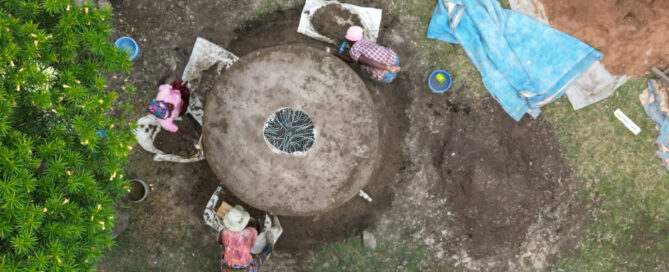
excavation for one of the tanks

numbers are all it takes to break it.

So that’s all the bad news. Thankfully it is also the news of the past. The excavation is well on its way and Joseph believes he can have the 144,000 liter rainwater harvesting system done in just  4 weeks! Wow did I smile when he said that! He is learning how to manage the team and his time so beautifully. When I look at him, it is hard for me to believe the journey we have walked together over the last 5 years.

For more information on Save the Rain or to make a donation go to www.savetherain.org

The Beginning of a New Project – Manyatta, Tanzania

January 13th, 2011

Check out a brief overview of this village at www.savetherain.org/manyatta.htm

We are so happy to inform you that our Operating Director, Kelly has landed safe and sound in Tanzania once again. Our team has begun the construction process on a rainwater harvesting system for the village of Manyatta, Tanzania.  Be sure to check back in regularly as we will be posting more updates from Kelly on this project. Enjoy this first update!

Kelly writes:

So the beginning of this trip was physically uneventful – thank God – so far no black eyes and falling luggage.  8 hours after leaving home, I had made it as far as Portland… out of harm’s way sitting in the sky lounge watching the people go by.  I watched the people roll on by on moving sidewalks, with wheeled carry-on’s and the infamous knowledge that there is always a toilet nearby that will flush for you. I felt caught in the time between here and there. Not only is day-night and night-day but the hours that separate us are simply reflections of what we constitute as essential. In this moment, my phone and my computer are the lifelines to my loved ones at home. After 48 hours of travel, I will be reminded of what a lifeline really looks and taste like.  The beginning and the end of each trip are always the hardest. Layovers make you miss your husband and family and pets. Leaving Africa makes you question if you have done enough, if you have worked hard enough, helped enough people with the time and energy you had available. There is a world between the seat I occupy right now and the one I will in 16 days from now – when I find myself back in this sky lounge waiting for the flight home.

This far into it – with this many trips under my belt, you might think it would be second nature. But the day the suffering caused by this crisis becomes second nature is the day I will have to rethink the commitment I have made. The seriousness has begun to wash over me. It is different in the field- laughter is a defribulator. It is essential in reviving your spirit in the face of all the hardships. Along with the seriousness, the sleeplessness came to me as well. I left home on the 8th, three days later, I have slept fewer hours than the fingers I have on one hand. All pretty normal stuff. But to my greatest delight was the sweet smell of the rain.  It rained as I walked down the stairs off of the plane, rained as I lay sleepless the first night. It rained on the way to Manyatta. My biggest smile came when I realized that not only were our rainwater tanks filling in that very moment, but the road to Manyatta was perfect – even in the rain. Wow – that was truly a first for me.

On my first day in the field, we had the village meeting in Manyatta. It is an incredible and intensely spiritual community and place. With Meru in the distance, the energy of the village meeting was so high. I have never been to a village meeting where the word God was used so often. It was amazing to see what the school has done in just 3 short months. An American sponsor who bares a similar name to me, a Mrs. Calman, donated the money needed to build a new school building – 2 more classrooms and an office – and replace the roof on the older building. The masons have just finished laying a new walkway and setting in the facia board and roofing sheets. We will work simultaneously while they build the new building.

The village meeting was awesome. So many excited faces! So many questions and none that related to personal advancement or greed. There were no gender issues pushed, no politics, and no unnecessary blah blah – amazingly there was only love. A man stood up and told everyone that they should mark this day on their calendar – 01.11.2011. He said they should remember it as the day that God answered their call, sent them the greatest gift and delivered an angel to help. I replied that though I appreciated being called a gift and an angel, we needed to remember that it is their children who are the angels and deserve nothing short of us working as hard for them as we do for God. The village leader cried out that they were hungry for clean water. The head teacher (for the third time) fell to his knees with tears of gratitude. The head of the school committee apologized that there were only 150 parents present. He explained that there was a funeral in the village today and that he was told to send us the apologies of those who could not make it.

The people cheered at the description of the project, the women applauded and giggled at the lottery, everyone asked intelligent questions about the women’s project but best of all, I sat back and allowed our crew to do most of the work. It was the best, not because I did not have to work hard. It was the best because they did it with so much grace and independence. It was another moment of being witness to sustainability taking root.

I will admit that equally as delicious as watching people take their power gracefully, was that I was able to witness it with Moses on my lap. His laughter is like breath to me. I could simply drink it in. The day before I arrived, he was jumping rope and fell on his face. He has scabs all over his nose and upper lip and an egg size bump on his forehead. As I put Neosporin on his wounds, he placed his hands on my head, kissed my cheek and said thank you. I am once again so deeply honored that this child chose me. I looked him in the eye, in those awe inspiring sparklers, and said, “No Moses, thank you.” He giggled this deliriously hysterical laugh and we fell on the floor together.

But the sweet moments are always followed by the awakenings. The interviews were heartbreaking. 100% of the community gets their water from the two rivers that line the village. Their spiritual wealth is as obvious as their physical starvation. I held so many women’s hands as they told me of their sick children. I held the hand of a 17 year old, who is now the head of her household. She has 5 siblings younger than her and both of her parents have died from water related illnesses. She is barely old enough to know herself, let alone know how to raise 5 children. But she is a monument to responsibility. She boils her water regularly and is working to keep her brothers and sisters healthy. During another interview with one of the mothers, I realized that we had arrived just in time. All of her children have been deeply sick with Typhoid and stomach problems. She lost her husband to stomach illness and has scars on her soul from loneliness. You can see it in her eyes. But when she speaks of her children, her love emanates and she is strengthened. Her name is Maria and she is angelic.

Julius, the head teacher told me he feels like he is the luckiest man in the world. Imagine, a man with so little, believing himself to be so lucky. But he is one of the luckiest men as he truly believes his prayers have been heard and answered. He shepherds this community and has prayed regularly for help for his students. They have been answered in spades. Not only will he have a new school, his school will have clean water for his whole community. So starting on Thursday, we will begin building a 144,000 liter rainwater harvesting system.

We stayed at the school until every parent had been interviewed. By the time we left, it was close to 8pm. We all felt honored driving home. We each recapped stories of amazing survival and inspiration. Moses fell asleep on Joseph’s lap in the back seat. His little snore was precious and his very presence is a constant reminder of why we do what we do.

For more information on Save the Rain or to make a donation go to www.savetherain.org

Some Thank You Notes From GCAP

November 18th, 2010

GCAP 2010

October 29th, 2010
On October 24th, Save the Rain attended the 2010 Global Citizenship Action Project in New York and was the key note presenter. GCAP is a conference for middle school Montessori students. The goal of GCAP is to inspire middle school students to learn what they can do to become better informed and more productive global citizens.

We are so excited to share that Save the Rain won a landslide vote by the students from Montessori schools around the country to adopt Save the Rain as their organization of choice to support next year!

The program that they will be adopting at their school is a simple:
W.A.D.A. – Water Awareness Day Alliance
In 2006, Mount Shasta High School approached Save the Rain about creating an awareness week around the global water crisis. Motivated by the fact that it only costs $15 to save someone from this fatal predicament, the students felt a call to action. Four years later, Mount Shasta High School’s W.A.D.A., the program we co-created, has helped Save the Rain bring clean water to over 60,000 people. It is now being initiated in schools across the country.

How it works: The Rain Runs and The Rain Dances!
We give American students a glimpse into the lives of African children struggling to survive the water crisis. They are then paired with a school in Africa. They then host a sponsored “Rain Run” where they show their dedication to the cause by completing a certain amount of sponsored laps around the school track / gym or block of streets that surround the school. Each sponsored lap costs $15. This means 1 lap = 1 life. American students harvest funds so that African students can harvest rain. American students spend one lunch hour walking for water so that African children never have to walk for it again.
Once the Rain Runs, then the Rain Dances.
American Students then host a Rain Dance, a party that not only celebrates their eff orts but gives them the chance to raise more funds and call in the rain! Save the Rain creates venues for the two schools to communicate with each other.

When The Challenges Are Great, The Victories Are Greater

March 24th, 2010

After a couple of challenging days in the field for our operating director, Kelly, we get to see the hard work finally pay off! 

 We will let Kelly tell you the story:

 This morning I awoke excited. We had scheduled a 10 o’clock meeting with all the head teachers of all the schools we had worked with in the area. It was to be held at the Namballa School which was the first school project we ever did.  I awoke early and prepared for the meeting – writing a questionnaire that when answered, would be filled with avenues of vital information that would help us improve.

 I spoke with Ranger Safari and they delivered two new spare tires for me and took the old one away. I was relieved that the tires would no longer be a problem.

 When Anna arrived, we went to collect the head teacher from Patandi. Her name is Hilda and she is an incredibly compassionate and powerful woman. Upon arrival at Patandi, the children rushed to the car. They kept touching my hand and then pointing to the tire. I got out of the car and the tire was almost flat. My frustration started rising. We went to a gas station and filled the tire. I did not want to leave any unnecessary openings today. I wanted the teachers to have all of my attention and appreciation and now we were late. When we arrived at the Namballa school, we were almost an hour late. No one was there. My disappointment was huge. The teachers had all been called that morning to reconfirm. Then the news came that Rachel, one of the most successful head teachers in regards to a Save the Rain project called to say she would not be coming. Rachel had a hysterectomy last year and struggles with her health from time to time. I offered to go and get her, even though it would take me another hour to go there and back. She said that she would send someone else. There was something about the disappointment that put me over the edge. It was now close to noon and I felt like failure was looming. So I did what I do so naturally. I cried. I thought about this war that we are fighting and how so few adults in this part of the world are fighting along side us for their children. I looked at Moses and thought about changing the whole direction of the organization. Anna reminded me of the school children at Patandi. How much healthier they are and how they pointed out my flat tire. She said to remember who we work for but she too had lost her patience. We left for Maweni to collect the teacher.

 When we arrived back at the Namballa most of the teachers were there. I put all my frustration aside and moved into the meeting. The first question I asked was about the successes. I asked the teachers to tell me the success stories that the clean water had written. One by one, they shared the most incredible news. I cried again but these tears were different. They were the tears of victory because every school is having the same results:

 Namballa – In 2009, 82 kids in standard 7 - 82 kids going to secondary school.

Kikwe – In 2009, 58 kids in standard 7 – 55 kids going to secondary school.

Maweni – In 2009, 28 kids in standard 7 – 28 kids going to secondary school.

rainwater test results from the schools

Karangai – In 2009, 39 in kids in standard 7 – 39 kids going to secondary school.

And it goes on and on….

 I was floored. Their enrollment has increased, their attendance is amazing, the children’s health has been elevated to a different caliber, their educational performance is remarkable. In almost every school, the numbers of kids continuing their education is almost at 100%. Every teacher agreed that this had only become possible because of the rain water tanks.

 We talked for three hours about the places where we needed to improve, protocol that they needed to instill, ways we could help and ways that they could help themselves. There was a teacher who had, at one point for a short period of time, locked the community out of the rain water system. I explained to them the spirit of the kichakuro, the squirrel – an animal that hoarded. I told them that if they did not share the water, the children would suffer. A child that gets clean water at school but not at home, can get sick from one sip. By sharing the clean water with the villagers, we ensure the children will continue to flourish. Then we went on to create a maintenance plan, an improvement plan, a governance plan, an educational plan, a farming plan, and a sustainability plan.

  •  The maintenance plan came about because the teachers are not receiving the help from the village leaders as we had hoped. So we created a plan where by each of them would purchase small items to keep at the school. Things like taps and valves – things that can break when there are thousands of children around. We created a plan that involves a rotation of students who will weekly be responsible for cleaning the tap stations so that no debris is left around. We created a plan where monthly they would check their gutters and filters. Everyone who felt unqualified to do the maintenance will receive additional education before I leave. I asked each head teacher to name a mason that worked on their project. Each of them did and felt comfortable enough to call upon their named mason when they needed something repaired. Each of the masons named had children that attended the school. If something big happened, each of them knew they could call Joseph and we would figure out the best way for Save the Rain to help. So the maintenance plan got sprinkled with more self sufficiency.
  •  The improvement plan came about when I asked about the failures, the pieces of the project that needed adjustments. One teacher brought up that every morning 2 clean buckets filled with rain water are deposited in every classroom. But the schools do not have enough cups for every child to drink from. Sharing cups proposes a health risk so I asked each of the teachers to give me the student head count, wondering if we could buy the cups. But when the head count tipped the scale over 6000, I knew that with our current money situation that would not be possible. So we decided to give every classroom an extra bucket. Each school will purchase antibacterial soap for every classroom. Each classroom will now receive three buckets every morning – two for drinking and one for washing. So the improvement plan got a splash of personal accountability.
  •  The governance plan came from the discussion around the kichakuro. Rachel, the head teacher from Maweni who was absent, never runs out of water. She keeps one tank on lock down for the students and one tank open for the community. She explained to the parents that women should come and collect drinking water only. The community is clear and never without clean water.Every head teacher adapted this practice to one degree or another. I think it came from the fact that no one wanted to be considered a squirrel. They began to refer to a selfish nature as a kichakuro. I realized that I think I may have just coined my first swahilli phrase! The teacher that did end up representing Maweni did say that the women are excited and waiting for us to begin the women’s water initiative. That thrilled me to no end and left me knowing that this new governance plan would ensure these children’s future in ways I have only dreamed of.
  •  The farming plan is really exciting. All the school farms are weeks away from tilling the soil and planting their crops. I have been trying to implement the passive irrigation and surface water collection portion but in some communities the farming committees have met with challenges. In this new plan, all the head teachers are meeting in Mbuguni and we will do an entire day workshop on passive irrigation. The teachers decided that when the time comes to till the soil, they will make it mandatory that the class 5 and class 6 learn these new methods. This ensures that the next generation of Tanzanian farmers knows how to harvest the rain. Talk about sustainability!!!! This leaves me with goose bumps!!! Just close your eyes for a minute and imagine a world where no child ever knows thirst or hunger!! Amazing.

 The last point of the meeting was about sustainability. I asked the teachers if they would be willing to meet every three months to discuss their progress and their challenges. They agreed and decided that they would rotate schools for the meetings so that the travel would be equally divided. They agreed that the next meeting would be held at Karangai. The teacher from Tengeru commented on how far that was for her to travel. She looked at me and asked what I would do. I answered her in a way that I never had. I asked her if she knew about turtles. She looked at me a little cockeyed. I told her that a mother turtle lays her eggs and then leaves. A baby turtle must find their way on their own or die trying. I explained to her that Save the Rain was the mama and she was a baby turtle. We were not leaving her but she needed to find her way on her own. I told her  she could either commit or not. I let go and put it back on her plate. It was risky and had she not taken up her sword on behalf of her kids, I would have found another way. But she did!!!!!! Not only did she stand up for her kids but the rest of the teachers started to refer to her as Kasa mtoto. Baby turtle.

 I spoke with them about clustering schools together for this sustainability plan. Then the roof came off the classroom. They started to talk so fast amongst themselves that I could barely catch a word of this beautiful sing song language. When they finally stopped talking to catch their breath, Hilda spoke on their behalf. She apologized for their disrespect in the morning, for keeping me waiting when I had something so important to share. She asked that I please know with all my heart that they stand alongside me, that any enemy of mine, is an enemy of theirs. She said that if any window allows darkness to come in, together we would find a way to close it. She informed me that they decided they would form a committee – the water teachers. Every time a new system was constructed in their cluster, they would gather together again to educate the new head teacher as to what works and what needs to be watched for. She said they would call the department of education to witness the completion of every project so that once and for all the government would know what progress they were making on their own. They would gather every three months and organize the travel together to reduce the cost for any one teacher. She went on and on about all their plans to raise themselves up and improve the lives of their students.

 I cried big huge baseball tears in celebration of their victory. They laughed at my joy and looked upon me differently. I realized then that when I cry, I am no longer a white American woman, I simply become another human being caring deeply for well being of their children.

For more information and to donate to Save the Rain visit our website at www.savetherain.org

Mama Mvua (Mother Rain)

April 1st, 2010

We are so glad to report that the project in Mbuguni is moving forward beautifully.  We are also happy to report that Save the Rain is now the proud owner of a SKYMARK ARROW 150CC off road motorcycle. This is a wonderful step up and a leap in our journey.  Now Joseph, one of our project managers, will be much more mobile to check up on projects in progress after Kelly is back home.

 Now… more from Kelly:

Shared a shower with a spider that was half as big as my fist. I put a glass over him, hoping he could hang out there while I washed. Would not think to move him as he was a little too big for my comfort zone. I named him Hank and we talked for a bit while I washed. Sometimes the nights get lonely. When I finished I removed the glass and he hung out there for a while. I prayed I had not hurt him as any life that survives here deserves a shot. By morning he was gone and I guess he did not like my conversation as I have not seen him since. I have now gotten into the habit of checking my towel before using it…just in case.

  Most days, the Macrocosm is so clear. There are no personal agendas, no amount of service that seems too great. With Moses ( Anna and Joseph’s adopted son) it always feels like the Macrocosm collided with the Microcosm. In my heart the lines blur. Moses has malaria, chicken pox and hook worm. He fell asleep on me during a meeting and soaked my shirt with his sweat. I was in bliss and truthfully, I wanted nothing more than to drive to the airport, get on a plane and take him home to protect him from the challenges of life here. But then the rains came and they created this booming symphony on the roof. I handed Moses back to Anna, walked out into the rain and let it wash clean the distinction. The rains are upon us now and they come daily in fervor. I know that I must come from the lineage of Mother Nature, as I truly love it more than anything. Every night I fall asleep to thunder and everyday we work in the rain. It creates interesting experiences and definitely some challenges. I often think of how I so look forward to the day when the funding flows as freely as the African rain does.

The rains have created transport issues. The roads into the Mbuguni village are terrible and when the rain comes they flood. I never knew a Land rover could swim but I do now! Driving to the village literally means driving through water that is sometimes up past the tires and into the car door. When I drive through it, I know to put the car in lock differential but I literally hold my breath until we are through. Finally we found a Roman Catholic secondary school that is very well funded and has clear roads to the main road out of Mbuguni. When the school said we could use their road for the remainder of the project, I felt my blood pressure lower substantially.

One thing that alleviates all my pressure is pay day. I love pay day. There is something that gives me great satisfaction to pay these men for their hard, honest work. They have so much gratitude and desire to learn. They also have just the sweetest nervousness. We have a pay voucher system. It helps keep track of the pay cycles but it requires everyone to sign their name on the voucher as they receive their pay. Most of them cannot read or write and it is always so sweet to watch them as they sign their name. It makes them feel so official. One man said that he has “Maji ya tumbo” –  water in his belly at the thought of signing a document.  It is precious. By the end of the project, they sign like pros. But in the beginning, it is a big deal. And there is also something about the first pay of a project that is like no other.  After they sign the voucher, I always shake each person’s hand. I tell them how grateful I am for their effort, their sweat and their willingness to learn.

 Once or twice a project, we work into the night hours. The rains had delayed us by an hour or two  and the foundations for two of the three tanks needed to be laid. So we did what we always do, we worked mixing concrete by the headlights of the car. We blared Anna’s cell phone radio and pretended we could hear the music over the sound of sand and gravel mixing with lime and cement. All 23 of us danced under the African night sky and laughed until we hurt. No one complained or looks to lessen their labor load. We work gleefully and it really is a celebrated joy. There are small pleasures that music brings to hard labor that is really indescribable. I decided that we were in need of a radio on the job site and would pick it up the next day. Theses men have so little and this simple small pleasure was easy to provide. I was happy, so happy….

 Until my heart crashed into a million pieces…

 Standing in the shadow of flying buckets and spattering concrete was a boy. His name is Leobahati. I was surprised that his parents would allow him to wander at that hour. I asked him how old he was – knowing that he must be somewhere around 12. He answered that he was 5. “5!” I said. “You can’t be five.” I knew in that instant that truly he did not know how old he was. I asked him where he lived and he told me he lived with a teacher. ” Do you go to this school?” No, he replied. “I do labor for the teacher in exchange for food and a small amount of money.” “Where is your family?” I asked. ” And how come you don’t go to school.”

 He proceeded to tell me a story about how when he was in the second grade, the school came to his father demanding his school fees. His father did not have the money so his education ended.

 ”Can you read?” I asked.

“No” he replied. My heart cracked a deep fissure, as I stared at his face.

 School fees run about $7 a year. I was floored that the teacher has not even taught him to read. How could people allow this to happen? Anna asked him if he had any plans.

 He went on to say that he would like to go to school but realizes that it is unlikely. So his alternative plan is to save enough money to buy a goat. Then he will get the goat pregnant and take it home to prove to his father what he’s worth something to his family. I kept apologizing to him. People had given up on him, that people had given him up, that no one stopped and demanded he be entitled to a childhood. If there was a Social Services to call I would have. But there are not and I was painfully reminded that he is simply one of millions.  Apologizing is something that this culture does regularly. It is customary to apologize to someone for their work day, for a long trip or simply for getting through the day. I wanted to apologize to Leobahati for his life. Instead I will arrange with the head teacher how this $7 a year tuition can get covered. Even then, he will be a twelve year old in grade 3 and the error of his parent’s ways will be forever imprinted on him in one way or another.

 I looked away to wipe a tear from my eye and caught the wire reinforcement for the second 50,000 liter tank being delivered to its new home. I turned to get Leobahati out of the way but he had disappeared into the night.  

 The work day finally ended but the celebration was not as sweet for me as there was a piece of Leobahati that had stuck to my heart.

 Saturday was an amazing day as when we arrived at Mbuguni the guys were well on their way adding the rebar to form the roof and the weld mesh and chicken wire. I love this part, as it is when things really begin to take shape. You can see it in everyone’s faces. This is when they truly understand the shear size of these clean water tanks. Excitement tends to fill the air and consciousness seems to elevate. It got even better when I presented them with a radio that has volume levels that everyone can hear. It would seem that boys are boys no matter where you are in the world. I would have assumed that they would have put on music to groove their work to. No – the football match blared for the portable speakers and they cheered for their teams as they worked away.

 There was a group of women playing a game that is partially soccer, partially basketball and partially something I have never seen. Kids had gathered around to watch. Out of the corner of my eye, I saw a girl with a water bottle in her mouth. She was sharing it with a small child. From a distance I could not make out if it was tea or soda. When I got closer, I realized it was water. Before I had a chance to say something, another young kid turned to us both and said.

“Mama Mvua (mother rain), shkamoo. (a greeting of respect) Miriam, do not drink maji chaf. (dirty water!)” She grabbed the bottle and poured out the contents.

 I cannot take back the sips that she took or the bacteria that is inevitably crawling around her stomach but we can celebrate that she and her peers now know that something better is coming. That rise in consciousness is worth celebrating.

For more information on Save the Rain or to make a donation go to www.savetherain.org

When The Roads Turn Into Rivers, You Better Learn to Swim

April 5th, 2010

We will be happy to have our Operating Director, Kelly back home in California in a couple of days.  However, we recognize how hard this must be for Kelly, as she has to say goodbye to all of our family in Africa.

From Kelly:

The rains are coming down in a way I have never seen. It has been non stop since last night. It puts a few wrenches in my day but I try to stay focused on tanks filling. 

For the last 3 days, the moment I awake, my heart is beating a mile a minute. I have said before that in this work, my heart is broken everyday. I am fine with that. But this racing feeling, I truly believe is in anticipation of leaving. I believe I will sustain a heart break on Monday like I have yet to experience in my lifetime. Not only because of Moses but because there is so much work yet to be done.

 But there is no stopping that train, so we move forward acknowledging the successes and the challenges.

 The project is moving forward beautifully, wire reinforcements are finished and two coats of plaster are on the large tanks. The system will be finished in about 3 weeks but will begin to collect clean water in less than 2. The need for the work becomes even more apparent in the wet season. Everywhere you turn, there are funerals – for children and the elderly, who are unable to sustain the whiplash of the water crisis. In the last week alone, we have had to reschedule 6 meetings with people who were burying children. When I drive out to Mbuguni, the river is overflowing and it resembles a charging vomit colored bull headed for its target. Fields in Mbuguni and Mstombogo are flooded. After a short rain, while at the school, there was 3 inches of standing water as big as a lake surrounding the car. It stayed there for the rest of the day. I watched in horror as shoeless children walked around, innocently playing. I tried to explain to all of them about parasites that enter through the feet. They laugh at first unable to believe such a mystery. But there is a trust they are intuitively having in me that after a small conversation, they put their shoes back on…. thankfully.

 I think one of the most stressful parts of my day is having faith that the car can truly swim. The roads have turned to rivers. This first photo looks like a shot of a river. But it is actually taken by me out the front window of the car.

 And this next one is the view on the way home. I hold my breath as we traverse these areas. Not so much for our safety but for the shear pain I feel for the people who live there. There are no berms holding the flood back. The houses are on the same elevation as the road. With no money and no other place to go, these people sustain this kind of travesty multiple times a year. I don’t think I could have ever really believed it until I experienced it myself. The smell of waste is indescribable in some areas. I never really understood the snorkel on the side of these safari cars until now.

 Thankfully once we leave the Mbuguni and Mstombogo area, the roads are a little dryer. There are still some rivers to cross but nothing that leaves me breathless. 

 I have had some truly great highlights on this trip and a great dose of the regular despair. Honestly there are moments, when even for me, the problem seems so big. When I look at the map and all the schools we need to cover, all the wards that have yet to be done, I have moments when I feel overwhelmed. But I am learning to tell myself to shut up more often and instead look at the change we have already helped to generate. Which brings me to some of the great highlights: We are creating quite a buzz in the area. We have received letters from 12 more schools requesting our assistance just in this week alone and 10 last week. I think this came from the fact that we initiated the sustainability plan with the teachers.  Initially, when we first started to teach passive irrigation for farming to communities, we had them elect a farming committee from the parent pool. But after the meeting with the Head teachers, I realized that particular pathway created obstacles. So we initiated some changes. I wrote about the farming plan which included teaching the teachers passive irrigation and then having them teach the 5th and 6th graders. Well, we had our first farming class with them this week and it went amazingly. Once again, when the simplicity of harvesting the rain is explained to people and they embrace it, it is like watching a light show performed by fire flies. It is a bounce of recognition, of light, that illuminates the room. Joseph and I worked with the teachers in the classroom for about 4 hours and then spent about 3 hours out in the farm. That was until the rain came. Once again everyone ran for cover and I let it pour down upon me. To experience it is like nothing I can describe. It is ancient yet fresh and loving yet wicked. Joseph is a perfect teacher for the farming plan as he has had years of experience teaching organic farming. He is such a giant love and he is so good at what he does.

example of Women's Water Initiative tank

 I met with the head teacher about Leobahati. He invited me to his home. We had a beautiful conversation about our mutual love for children. As soon as the kids are back in school, he will enroll Leobahati, make sure he is housed and fed properly, tutor him so that he will learn to read and write more quickly and take him under his wing. Jeremiah (the head teacher) and I talked about how at Leobahati’s age, he is on the precipice. One nudge in either direction could send this kids reeling – either to create a better life or to become a thief. The fees are more than I though but laughable all the same. $29 is what it costs to show this kid that someone cares about him. I truly think that is all it will take to help him stay on track. It was a relief to know that Jeremiah is starting a program for kids like Leobahati. Mbuguni is one of the villages where tanzanite is mined. You used to be able to find it on the side of the road. Kids used to play with the beautiful precious gem like it was an old worn stone. When the value of the gem got well known, parents sent their kids out to find it instead of sending them to school. With the severity of the poverty here, it really does not surprise me. So the amount of kids like Leobahati are many. I was happy to hear Anna say that tanzanite is now harder to find. She believes it’s because God wants kids in school. I laughed and thought about the fact that I was pretty sure the cruise ships had something to do with the lack of Tanzanite. But I stopped myself from telling her and decided it might be better to leave her with her faith. When we were about to leave Jeremiah’s home, he asked if he could speak with me about one last thing. We strolled outside. Jeremiah lives on the border of Namballa and Kikwe. He said:  “I hope you know that I love the rain as much as you.” I smiled and he continued, “I wondered if there is a way I could harvest it at home.” I jumped like a frog. I was so happy. Jeremiah and his family are such positive influences in the communities. I giggle as I told him that his wife could participate in the initiative program. He will officially be house number 26 in the women’s water initiative. He was elated and has such an eye for what is down the road. Together we stood for a moment basking in the glimpse of a future where villagers lived without the pain of the water crisis.

 But, like I said, an equal dose of success and despair. I am sorry to report that the women’s water initiative has sustained a heartbreaking but hopefully temporary loss. Lilly, one of the smartest, most powerful and loving women I know, and one of the best teachers in our program, has had some serious health issues. She is transferring into menopause and it is not going well. She has spent weeks in the hospital and they are offering her little help. Her whole body swells and she says she can feel her blood thicken. Listening to her really reminded me of how incredibly strong the women are here. They are so regularly told to live with their pain. When I met with her, she cried in my arms. Not for the pain she felt in her body but for the pain she felt from being separated from the project. She kept telling me that her whole heart is in the women’s water initiative but her body is too weak. She said this project allowed her to be a part of something that would effect change. But her body was damming her participation. I held for a while and told her not to worry. I would find a way for her to stay connected. Please she kept saying, please. I have yet to figure it out but I will. Lilly said she thinks I worry so much because I am always trying to outsmart my enemy. She said she feels I keep multiple solutions in my pocket just incase one does not work. I laughed and thought that there was finally a silver lining for the part of me that waits for the other shoe to drop.

 Anna and I made some house calls to women who had received their systems in the women’s water initiative. With the rain, we were limited to who we could get to. A precious woman named Martha was one of the recipients. I was so moved by her gratitude. The moment we arrived at her home, she took my hand and would not let go. I had to force her just to take her picture. She fell into my arms and kept thanking me. She is a grandmother and cares for 7 of her grandchildren. She kept telling me how much she loves me even though we only just met. She kept taking my face and telling me that God would bless me for the work. I explained to her that there are many who are responsible for this project moving forward. She kept yelling that God would bless us all. I told her that I don’t do it for the blessings I will receive in the long run. I do it to balance the scales of injustice in the world now. The moment the words came out of my mouth, she pulled me into her house. I said: ” Martha, Viatu Chaf sana!” (my shoes are so dirty) She laughed at me and said the floor of her home was made of the same mud on my shoes – a little more would not hurt. She pushed me down to sit on her couch. She sat across from me and told me that I must have a cup of tea. I told her that I couldn’t because I do not drink tea. Anna went on to list all the things I don’t eat or drink. Martha looked at me as if I were nuts. She insisted that she had to serve me something. I asked her why. She said we needed to share in something so that I could consider her my friend. I lowered my head in humility. Her grace was so exquisite. I have come across this custom before but never like this. I said knew what we could share. Her eyes lit up like fire. I took her hand and said quietly. ” We could share a laugh.”" And so we did.

I am happy to report we can add two more Tanzanian businesses that are supporting our work. So not only Ranger Safari and Aim Steel Nikhil but a company that makes (of all things) buckets!  The company donated 175 clean water buckets to Save the Rain. Got to love that!!!!! The second company holds the largest African antique collection and runs a museum like heritage center.They have a charitable trust and are interested in donating. I will submit a proposal to them when I get home. They also donated some beautiful antiques that make me truly jealous that I won’t be able to participate in the auction!

Tomorrow, I have a huge job ahead of me. I am going to church! But not to pray or to reconcile. But to become the official God mother to one of the great loves of my life! I even have to wear a dress. All I can say is Lord Help me!

For more information about Save the Rain or to make a donation visit www.savetherain.org

Water Crisis Awareness Week

April 15th, 2010

making a 2 minute shower pledge

This week, Save the Rain has joined with Mt. Shasta and Weed High School Key Clubs to host a week of fundraising activities from April 13th -17th.  On Tuesday April 13th Save the Rain will be giving a school-wide assembly to talk about the global water crisis and our projects in Africa. Wednesday April 14th and Thursday April 15th will be student-led, in-class presentations where students will be learning more about the global water crisis and can make a 2 minute shower pledge.  Friday April 16th, we will be hosting a “Rain Run”, where students will be showing their dedication to this cause by completing a certain amount of laps around their high school’s tracks (1/4 mile) costs $15.  We chose this amount because $15 can provide a villager in Africa with water for their entire lifetime and that of their offspring.  There is no minimum amount, so whether you would like to sponsor 5 or 50 laps, everyone is invited to participate.

 The week will end on Saturday April 17th with a huge benefit including a slide show, silent auction, yummy food – provided by the Mt. Shasta Supermarket and a live African Band. Tickets are $15 for adults, $10 for students, and $5 for children 8 and under.  Please join us to help raise awareness and funds for projects that promise to save millions of lives.

6:30pm – 11:00pm Sisson Elementary School Gym

601 E. Alma St.  Mt. Shasta, Ca

Tickets are available in Mt. Shasta at Native Grounds Nursery, Spring Hill Nursery, Village Books, Snip & Save or you can go online to www.savetherain.org.

Live Music from Jujuba

“…Jujuba ignites a more primal sense of movement.  The funky,
feel-good 11-member group’s lavish use of drums creates tunes based on traditional Nigerian folk music that are sure to get you moving.”
-Karla Starr, Portland Mercury August 31, 2005

Also featuring music and slide show presentation from

Luther Red

“Luther Red celebrates the diversity of life and cultures this earth offers.  We are striving to make a difference musically,  to unify people without judgment and to create a positive change for this  environment and its inhabitants.  As always Luther Red is “maintaining the integrity of real music”

Workshop 2010

May 11th, 2010

Over the weekend of May 7th~9th 2010, Save the Rain held a workshop in our beautiful home town of Mt. Shasta, Ca.  The purpose of this workshop was to demonstrate the construction of  rain catchment systems similar to the style that we teach the women in Africa to build for their homes through our Women’s Water Initiative. (www.savetherain.org/wwi.htm)   At the workshop we demonstrated how to use commonly found materials and ancient / passive technologies.  We covered methods for both roof water collection and surface water collection.

For those of you who could not make it, here is some of what we covered.

Rainwater Harvesting Ethics (Brad Lancaster)

1. The Care of the Earth:

This ethic reminds us to care for all things living and non living, including soil, water, air, plants, animals, and entire eco systems.

  • Harmless and rehabilitative activities
  • Active conservation
  • Frugal and ethical use of resources
  • Right livelihood.

2. The Care of People:

This ethic directs us to strive to meet our basic needs for air, water, food, shelter, education, fulfilling employment and amiable human contact in ways that do not prevent others from doing the same.  We sustain a basic quality of life that improves our environment while enabling others to do the same.

3. Reinvestment of Surplus Time, Money and Energy:

This ethic enables us to achieve the aims of people and earth care by encouraging the extension of our influence and surplus energies to help others .

Rainwater Harvesting Principles

  • Begin with Observations
  • Start at the highpoint of your “watershed” and work your way down
  • Start small and simple
  • Spread and infiltrate the flow of water
  • Always plan for an overflow route, and manage that overflow water as a resource
  • Maximize living and organic groundcover
  • Maximize beneficial relationships and efficiency by “stacking functions”
  • Continually reassess your system: The feedback loop.

Appropriate technology (AT) is designed with special consideration to the environmental, ethical, cultural, social, political, and economical aspects of the community it is intended for. AT prefers labor-intensive solutions over capital-intensive ones, so as not to sustain high capital or maintenance costs. In practice, appropriate technology is often something described as using the simplest level of technology that can effectively achieve the intended purpose in a particular location.
Components of a Rain Catchment System:

  1. Catchment Area – the surface upon which the rain falls. (roof, road, patio, hillside)
  2. Conveyance – gutters, downspouts, swales and piping – the transport channel from catchment surface to storage.
  3. Prefiltration – Leaf Screens, First Flush diverters, Roof Washers, Silt Basins – the systems that remove contaminants and debris,before entering storage.
  4. Storage Tanks, Ponds or Lakes, Soil – where collected rain water is stored.
  5. Distribution – the delivery system that distributes water to desired uses.
  6. Water Treatment – filters and equipment, such as cartridge filters, UV systems, ozone, reverse osmosis, slow sand filtration, that settle, clean
    and disinfect the water.

Benefits of collecting Rain water:

  • Having a self sufficient clean drinking water supply.
  • A cost effective alternative source of water.
  • Reduces the demand on the water shed. Helps to replenish the watershed
  • Filtered rainwater is soft water with low mineral content and if done properly has low possibility of contamination
  • Unfiltered rainwater is preferred by plants and trees over most well water and municipal water sources. Can increase crop production by 4 to 7 times.
  • Reduces erosion, flooding and pollution caused by runoff.
  • Filtered rainwater costs substantially less than bottled water.
  • Water storage for fire protection.
  • Tax credits and rebate programs available in many areas.

Instructions for building a residential Rainwater Harvesting System:

1.Determine roof height. Tank penetration must be at least 2.5’ below gutters. If roof height allows for the tank to be 2m high, than create a foundation that is 1.75m in diameter. Always allow for a 3” lip in the foundation. If roof height is lower than do 1.75m in height and 2m foundation.

2.Lay half of the foundation with a concrete mixture. Allow to set.

3.Create a ring out of the gi wire and connect 16 pieces of gi wire that extend 3 feet past the lip of the foundation, in a starburst fashion equally spaced.

4.On top of the g.i. wire lay out three pieces of chicken wire, overlapping the pieces by at least  4” with 3’ extending past the lip of the foundation.

5.Connect an 18” horizontal ¾” gs pipe to an elbow with a 3” vertical ¾” gs pipe to create an “L” shape. Set the pipe under the chicken wire, poking through with the vertical piece (the inlet) close to the center of the foundation and the horizontal piece (the draw) coming out over the lip of the foundation

6.Dig three 18” holes around the foundation in an equilateral triangle. Set in posts. Post are 3m in height. Using 4” nails, at 2.5m, nail horizontal pieces to create crossboards.

7.Bag dimensions are 2.5 high and 2m circumference.

8.Hang bag from cross beams securely using binding wire creating as cylindrical a shape as possible.

9.Elect a mole (person who will be in the bag to move saw dust around). Have the mole crawl inside the bottom of the tank and lay bricks on the circumference of the bag to anchor it down. Place the ladder on the inside of the bag as well.

10.Begin to move saw dust into the bag by passing them to the mole in buckets. Every 2 feet of saw dust fill, adjust so that it is equally packed and the bag is tight. You are creating a saw dust form inside the bag.

11.When bag is filled two feet from the top, remove the wire that hangs the bag and using binding wire, close the bag. Then add additional cross bars to the wooden frame closer in and hang the sealed section of the bag with binding wire. This adds additional support to the bag.

12.Clean the exterior of the bag of any excess saw dust and in an area close to the tank begin to lay out a plaster missing station. Remember only make as much plaster as can be used within 30 minutes.

13.Make a cement slurry mixture and set it in between the base of the bag and the foundation. This connects the walls to the floor.

14.Begin to plaster. First coat is very rough. Make sure when you add plaster at the floor that you are filling it so that there are no air spaces. Plaster just over the lip of the top of the bag.

15.Wrap tank in plaster and allow it to set over night.

16.Reinforce tank with gi wire, binding wire and chicken wire. Then connect vertical pieces of gi wire to the pieces in the foundation so that they surpass the top of the tank. Then wrap with chicken wire. Run horizontal hoops of gi wire on the bottom part of the tank every 3” and at the midpoint switch to every 8”. Wrap the whole tank in binding wire so that the reinforcement is tight.

17.On the outside do 2 more coats of rough plaster, making sure you scratch the plaster into the holes of the chicken wire and then 1 coat of smooth plaster. 1 coat per day and always wrapping in plaster each night for curing.

18.Remove the bricks and the saw dust and peel the bag from the walls. Clean interior well and do one more coat of plaster on the inside walls and floor. Then one coat with water proof cement paint.

19.Set in over flow pipe at the top of the tank – ¾” gs pipe that is 24” off the top of the tank and vertical is the length of the tank direct it to a needed place.

Here is some recommended reading:

Rainwater Catchment Systems for Domestic Supply: Design, Construction and Implementation
~ Erik Nissen-Petersen , John Gould

Introduction to Permaculture ~ Bill Mollison

Water Storage: Tanks, Cisterns, Aquifers, and Ponds for Domestic Supply, Fire and Emergency Use–Includes How to Make Ferrocement Water Tanks ~ Art Ludwig

Rainwater Harvesting for Drylands (Vol. 1): Guiding Principles to Welcome Rain into Your Life And Landscape ~ Brad Lancaster

Rainwater Harvesting for Drylands and Beyond (Vol. 2): Water-Harvesting Earthworks  ~ Brad Lancaster

As a volunteer for a nonprofit that does sustainable community development work in rural South Africa I recently attended a rain catchment workshop held by Save the Rain. It was an incredibly valuable experience and one that I highly recommend to anyone concerned about local, regional or world water and environmental issues. We were given an immense body of knowledge about “how to” assess, implement and review rain catchment projects involving local communities in building structures to catch rain water. Information on surface catchment strategies, both small and large, for the developing world as well as for the developed world and our individual homes was also given. Included in the workshop were hands on experience in building a small rain catchment tank. Dylan and Kelly have years of experience that they generously and continuously shared throughout the workshop. This was a learning experience filled with fun and stories from the field that was suited for the novice as well as people who already have a body of information about rain catchment. As a novice in this arena I have come away with many resources, knowledge and confidence that these types of projects are very doable. Thanks so much, Save the Rain!!! 

Melody Long, Gig Harbor, WA

Kiwanis International Convention 2010

July 7th, 2010

In June, Save the Rain had the privilege of attending the 2010 Kiwanis International Convention in Las Vegas.  Though we were slightly out of our element in the middle of the Nevada desert, the conference exceeded our expectations. We thank all of the Kiwanis members and our new friends for making our first Kiwanis convention such a warm and amazing experience.  It was wonderful to be in the company of so many people working to make the world a safer place for children. We know that the best way to create the greatest impact and help the most children is to work together.  We look forward to future partnerships and service opportunities with Kiwanis and Key Clubs around the world.   We would also like to thank our corporate sponsor, CCG for printing all of our brochures and flyers and for making this trip possible. 

Thank you LUSH Cosmetics

July 8th, 2010

Save the Rain would like to introduce our new corporate partner, LUSH Cosmetics. LUSH is a Canadian based company with retail stores all over the globe. They invent all of their own products and fragrances and make them by hand with little or no preservatives and minimal packaging. They even prove the authenticity of each product by putting a photograph of the person that made it on their containers (which are made from post-consumer recycled, recyclable, and biodegradable products). Also, they never test their products and ingredients on animals, or engage with third-party suppliers to test on their behalf.  

Our favorite product… the Charity Pot!  100% of the retail price (minus taxes) of their Charity Pot hand and body cream goes directly to worthy causes.  Save the Rain is so excited to announce that we have been selected as one of their next Charity Pot recipients. LUSH supports environmental, humanitarian and animal rights charities.  LUSH is an ethically driven company and they only select non profit partners that share those core values. That’s why they created the Charity Pot, a delightful hand and body moisturizer with the fragrance of a spring garden (although we think it smells like white chocolate – be careful not to eat your arm). Every penny of the retail price (excluding taxes which must be given to the government) goes directly to the charities they support. What an approach to philanthropy and profit - a model to be emulated. Thank you LUSH for your support, for your fabulous, yummy, eco-friendly products, and for your incredible social consciousness!   www.lush.com

Thank you

August 17th, 2010

Save the Rain would like to send out a giant THANK YOU to everyone that came out to support our 5th annual garage sale! It was a huge success! Never in the five years that we have held our garage sales, has there been such a wonderful turnout of donations and purchases.  It is so magical to see the exchange of energy from one person’s trash turning into someone else’s treasure with the result being clean water for children in Africa. Not only were we able to raise money for Save the Rain, but this magic was shared. Children in India and the Philippines will benefit from the clothing donations that were made, as a representative from an organization that brings clothes to orphaned children was able to receive a giant bag of wonderful clothes.  Also, a center for the homeless based out of Mt. Shasta was able to receive some great furniture and clothes and an organization in Weed helping mentally disabled and homeless people received a large amount of left over clothes.  It is truly amazing to see how such a small amount of generosity by a large amount of people can make such a huge difference. Thank you again.

We would also like to let you all know that we are going to be heading back to Tanzania on Wednesday August 13th. Here is a little information about the village we will be working in:

The village of Mstombogo has been selected as the site for our next project.  It has a population of 4,000 and yet only 400 children attend the Mstombogo Primary School.  It will be interesting to see the data that is collected from the parent interviews as the ratio of population to children who attend school is so small. As this primary school is the only one in the community and mining is common in the area, we fear that parents are sending their children to go hunt for Tanzanite instead of sending them to school. As the search for Tanzanite becomes more and more difficult, the risk to children increases drastically. Though it is our belief that an education is invaluable, in mining villages, it is essential for schools to provide something more enticing than scholastics alone. Once clean drinking water is available at the school, it will be interesting to see how significantly the enrollment increases. It is what makes this project so important – not only will the presence of a large scale rain catchment system provide clean drinking water, it will also provide the inspiration to get children to attend school.

Mstombogo has other great challenges as well. Driving through this community, the abject poverty and dramatic drop in any economic development is apparent. Almost every house is constructed with dung bricks and a thatched roof.  If the roof is made of metal – it is scrapped pieces that have been salvaged. Mstombogo is situated in an extremely flat part of the region and neighbors Mbuguni, the location of our last project.  Similarly, three major rivers converge just uphill from this community and so flooding becomes such a serious issue.  Each time it rains heavily, it is common for there to be about 2 to 3 feet of standing water throughout the entire village including the school. Because of this, the children suffer tremendously. Each time the floods occur, the school must shut its doors for weeks until the flooding subsides and the damage to the classrooms are repaired.  There is no education about flood-tolerant crops, so malnutrition is visually apparent. But probably the worst affects from the floods are the guaranteed cholera and typhoid outbreaks that follow. The equation of severe poverty and illnesses that require 6 months worth of medication can prove to be fatal.

Our objective is to build a 120,000 liter rainwater harvesting tank on the Mstombogo primary school. However, because of the extreme flooding, we are going to engineer systems that will have at least 3 feet of foundation. This guarantees that the tap stations are always well above the flood waters so that the rainwater cannot become contaminated.  We will also be orchestrating a community Earthworks project. This work will educate the villagers on flood control, infiltration and diversion tactics. The goal will be to divert the water away from residences and common gathering places at the same time as enriching the soil moisture to increase their crop yield. Because rainwater harvesting is naturally sustainable but always sight specific, we need to increase our budget for this project to accommodate the flooding circumstances. We are asking for your help. The children of Mstombogo are juggling so many of life’s obstacles. Together, we can turn the challenges into opportunities that will improve their lives.

As we embark on this project, we will be posting more blogs. So check back to follow along.

First Days In Mstombogo

August 27th, 2010

We are so happy to report that our team has landed safely on the ground in Tanzania. Kelly our Operating Director and Kori our School to School Coordinator are in the beginning stages of this project- the primary school in the village of Mstombogo.

Kelly writes:

So sorry that it has taken so long to write, but these last five days have felt like five months. Moving through the regular paces of insomnia, amoebas, fever and heart break. No matter how many times I do this and how many people I see in abject poverty, I never get used to it. I never have a moment where I expect the suffering I witness. My heart is shredded every time – almost as if it were the very first time. No matter what the small inconveniences I suffer, it is but a dust mite in comparison to the people we are trying to help.

At the same time I am learning some interesting and rather painful lessons about taking care of myself. I learned that because when I had the chance to upgrade Kori and I to economy comfort with my accrued frequent flyer miles, an area with only twenty seats and far more room, I hesitated to take care of us. In turn the Universe smacked me in the head literally. In the ten minutes I slept on the 14 hour flight, the man next to me drank himself stinky and turned our little row toxic, the woman behind me opened the overhead bin which when they warn you to be careful because your bag may have shifted during the flight, they actually mean it. But she was not careful at all and my 50lb carry on came flying out of the bin and hit me in the face providing me with a nice little shiner and a big fat bruise across my chest. I think I am having to balance the idea that it makes me no less of a person for needing a little more care in preparation for the giant task that I undertake when I come here.

Africa has been wonderful to share with Kori. Truly the best gift is that it has been so much easier for me with her here. It is beautiful to watch her extend her heart to everyone, to cry at both the beauty and the extreme inexcusable imbalance of this place. The children and people take to her instantly, awed by the size of her physicality but mostly by her light. It is wonderful to have someone to relight my candle when I become overwhelmed and to have someone share in both the trials and the victories. I am so grateful.

Though, as usual I was sick even before I got off the plane, day one was such a treat.  It was great to come home to my family here. There is so much love. In the morning, with barely any sleep, I awoke, dressed quickly and ran outside to find Moses running toward me. I threw my glasses, my keys and even my backpack to the ground, and ran to him. We hugged and twirled and I cried and laughed simultaneously.

We spent the morning creating the calendar and organizing for the village meeting and tank construction. This project is a little different than any other we have ever done. The soil conditions are unstable and when you consider that we are building something that when it is full will weigh 122 tons, stability is just a little important. Because the community floods so frequently throughout the rainy season, three and a half feet of the soil subsurface is like dust. After that there is about a two and a half feet of clay and then the hard pan. Only a small group of people here understand our due diligence but it gives me great peace at the end of each day. I witnessed the flooding in Mstombogo in April, the after effects and the devastation.  I know that we must guarantee this projects success and stability of this system. Being with Anna, Joseph and Kori is like this amazing Kaleidoscope…so many gifts at the table that when they gel, an explosion of color erupts. But more importantly this common thread binds us together, in that we have each put these children first and are prepared to do whatever it takes to get this crisis to an end.

It was bittersweet to get behind the wheel of our car. She is a beast of a beauty and though she is showing her age in various places, she handles the road with strength and determination. The roads I assume are a little like childbirth. Grossly uncomfortable and somehow unforgettable until you are upon them again. Kori is excited in that she may just be two inches shorter when we return home. I on the other hand can’t really afford to be any shorter than I am. Fortunately, the driver’s seat in the car still moves forward to enable me to touch the petals. The roads at this time of the year are interesting- rocky from the summer rains and filled with invisible pot holes that force me grind my teeth to avoid them at the last minute. Driving out to Mstombogo, I am thrilled by the improvements I see in the villages we have already worked in and heart sick by the villages we have yet to get to. I know that I have to simply find peace in that we are moving as fast as we are financially capable. But at the very glimpse of a child that I know is condemned to surviving dirty water, I am instantly pained and frustrated.

Upon arriving at Mstombogo, there were very few parents present for the meeting that was called. With a fair amount of experience under my belt, I had expected it. It was Saturday and market day and the only day that the available Dala Dala day (the crazy public transportation that is really just a minivan with 50 people and 120 goats and chickens piled in it). We rescheduled the meeting and it gave us an opportunity to reassess the site and measure exactly how we were going to tackle this construction. It also gave us an opportunity to witness the very desperate conditions that exist in this village. One of the teachers had attempted to do a fish pond. Beautifully the soil is still holding water a month after the rains. But the fish had all died and the standing water now looked more like vomit that water. A moment after trying to breath in the strain of this situation, a little girl walked over with a bucket, no shoes and submerged her feet in the water. She dropped her bucket, scooped up the avocado colored water and went to go offer to someone for a drink. Anna went after her, to educate her on parasites that enter through the feet and thankfully she reemerged for a repeat performance but this time with shoes on. Children gathered as we  plotted the communities new rainwater harvesting system. Their eyes were drawn and sunken in with dark circles underneath them. What I took notice of the most was that the whites of their eyes were not white at all but a deep yellow color. Later in the day, while sharing some the tales with the hotel staff, we learned that yellow sclera can be caused from yellow fever, severe malnutrition and a disease caused by snails in the water which deeply impede the liver. The day ended by celebrating Rose’s birthday (Anna and Joseph’s youngest daughter).

By the time we went to bed, Kori was moving through the emotions of her first African day. The normal onslaught of painstaking feelings that bared their nasty teeth and gnarled their roaring gnarls – despair, anger, heart break and then while stewing the bowels of the unfairness of the world, a strength and resolution arrives that fuels you towards the next day.

Gathering The Heartbreaking Data

August 28th, 2010

 Here is another peak into the progress of changing life in Mstombogo-

From Kelly:

And so day two arrived. While in the states, we went through the exercise of envisioning the growth of the organization. Seeing it scale, helping multiple villages at one time, bringing clean water to  children every day and dreaming of what would be possible with the right kind of funding. When we worked out the growth for this amazing place, I dreamt of an office, with a garden in the back, with storage on the sides for inventory and distribution of all the materials. I dreamt that it was close to town, that it felt safe and secure and maybe even a little like home. I shared my vision with Anna and she has been on the hunt ever since. The owners of Ranger Safari are the ones that have been so very generous by lending us a car for free. They have a farm house close to the hotel that literally has everything on my wish list!!! A farm for the Moringa project, storage for the materials that were once chicken coops, a great office space with stable electricity, completely secure and an amazing view of Mount Meru!!! Fingers crossed, we can figure it out together. It was good that Sunday was a day of meetings as I think everyone needed it to prepare for what the next day would bring.

We collected the guys who have been our small core crew from other projects. Their job on the project is to help teach the local masons and laborers this new construction style. It moves the education process forward more swiftly when there is a smaller ratio between teachers and students. It is always comforting to travel with them as well. We laugh together and have become quite a family. It turns out that Nicodem, a laborer who has been on every project got engaged to a woman he met in Mbuguni on the last project. It was great to tease him that he needed to thank Save the Rain for finding love. But maybe that is the miraculous beauty of Save the Rain. When one does good for others, the Universe does good by them. 

When we arrived at the school, the students were being sent home to fetch their parents. Within minutes they all arrived. It is always a challenging and yet invigorating experience to go through the community sensitization process. There is a moment every time when I find my heart in my mouth and a well of tears arrives that I have to swallow back. It comes at the very moment I ask them how many of them boil their water before drinking it. Only 10 people raised their hands when the question was posed. It is after this moment that I have to show them the water quality test from the water they are currently drinking. I have the daunting task of explaining to them that the black dots in the water test are fecal content and the red ones are blood and bacteria. I have to walk around the gathering and show them the picture. It is at that moment that we stare each other in the eye and the souls of these people lock themselves into mine. It is in that moment that their pain embeds itself in my heart and their plight becomes my own. It takes so much for me to restrain myself from wanting to take all these mothers and find a place where the loss of their children is a far away memory. We unfortunately cannot wipe away the pain of their yesterday. But we can help them find an easier tomorrow. And so that is what we do, I then show them the picture of what tomorrow’s water will look like and we beg them to boil the water that they have today. 

The meeting moved forward in an interesting way. Rarely have I seen one so heated. Apparently at one point when we were discussing the laborers and masons that we would need to employ, the village leader chimed in that he thought the women should be laborers on the project as well. I hesitated but jumped in when I noticed the weight that came over the women’s faces. I stood up and looked at the men. I told them that the women could most definitely share in the employment opportunity. But only if the men were prepared to fetch water and prepare the meals for the family, tend to the farm, clean the house and care for the children and livestock. If they were prepared to do that, we would be more than happy to have the more women on our team. The village women cheered. This was bittersweet. It was wonderful to be able to come to their defense, but at the same time to truly be thrown into the reality of their daily lives, was really hard.  I think when they define survival of the fittest, there should be a picture of an African women, in all her beauty, stamina and resilience. Their strength and ability to survive this life is inconceivable. And we had yet to hear their stories to truly know the scope of how strong they truly are.

Usually when we do the parental interviews, I am the one that gets all the parents who have lost their children over the last five years. I hold their hand as they tell me the story. I cry and apologize for their loss. In Mstombogo, the amount of parents who have buried their children outweighed those that haven’t. As I looked around at all of our interviewers, they were all reaching across the tables to hold the hands of parents who were recounting their pain. In reviewing the data afterwards, over 90% of this community has dealt with typhoid, malaria, bleeding kidneys, lung diseases, worms and water born parasitical stomach illnesses. More than 70% had had diarrhea for more than 2 weeks. So few of them grow their own food because their land floods. There is no pipe line or well in this village and everyone collects their water from the very river used as a toilet by thousands of others. A single digit percentage of them boiled the water. Their desperation was palpable and yet their beauty was outstanding. It was like light reflected against the darkness of their life. It is always amazing to sit across the table from someone you have only just met and be invited into the most vulnerable part of their story. We all take the hand of the parents when we are done interviewing and we shake it. It is our promise, our palm to palm vow, that together we will make life better.

When the interviews were over parents gathered with masons and laborers and began the excavation for the tanks.  When we arrived back at the end of the day, the comforts of our room and the safety it offered seem surreal. It mirrored the unfairness. Sleep was hard to come by that night.

Sharing Water With Hunting Lions and Bathing Cattle

September 1st, 2010

So sorry to everyone for the lapse in blogging, the days seem like a month long and the hours seem like days. At the end of the day when I close my eyes, I wonder if I am showing signs of early aging through memory lapses or if the morning was really just so long ago, that details are justifiably  blurry.

Anyway, going back to where I left off…

Wednesday morning arrived and we were fortunate enough to be invited along with our friend Helen to visit an organization called MPDI. They have been noted by the Global Fund for Children for their outstanding work. They work in the Monduli region of the area, a very dry area about an hour from Arusha. Ranger Safari provided us with  the funniest driver. His name was Alfred and he called himself the Black Mamba which is Africa’s most dangerous snake. His humor served to be a great relief to the days heart ache.

MPDI is an organization that determined that the Masai were losing their culture due to poor educational options or that they were not choosing to send their children to school because the school’s proximity to their village was simply too far. MPDI created satellite schools that provided early childhood educational opportunities for young Masai children. The centers can be as simple as a meeting place under a tree or as advanced as a fully registered primary school. MPDI has helped to create 38 of the centers and is now helping over 2600 masai children get an education that honors their culture and language. Mr. Sanare was our host and he took us out to two of the centers that MPDI mobilized. The first was about an hour drive from Monduli. We headed down the tarmac road and about 38 minutes later with not one distinguishing characteristic we simply turned off the road and headed through the dust out to nowhere. I wondered at that moment that if we were to help MPDI get clean water to their centers, how we would give directions to the material suppliers delivery man. “About 38 minutes on the tar mac, turn at the bush on the left, the one with the prickly pins, with the branch that points upward.” After a few minutes of contemplation, I realized I was simply using this as a diversion to calm my aching bones from the bumps. I also was trying not to notice that after an hour of driving we had yet to see one water source. I knew that my intense passion for our work and my deep compassion, mixed with the dire need of the people, was bound to get my creativity going. About 22 minutes later, we came to a stop at another non descript bush on the side of the road and were informed that we should get out. When we got out of the car, the most exquisite sight and sound came towards us. Masai women in full regalia with beads, wedding rings around their necks and headdresses were dancing towards us with the most lovely bird like song coming from their lips. It was like we were caught in some far away time, in some far away land with a culture that had decided not to notice that the world was changing around them. I had a moment of jealousy, that even with their intense hardships, they had each other and a deep connection to their people and their land. It blurred a moment later when one of the masai warriors checked his cell service and then the time on his timex watch.

There are so many times while I am in Africa that I look about me, and past the poverty and sickness, past the corruption and the stupid imposing abuse of power and feel a longing to belong to these people. There is so much suffering and yet at the same time so much exquisite simplicity. Home is an incredible place, filled with opportunities for service and advancement that parallel nowhere else. But it also comes with so many complicated layers that I often don’t understand. I am so grateful for the opportunity to peak into Africa’s simplicity and hope that in some small way, I can emulate that genius in my own life.

The Masai led us to a small building with sticks for walls and a metal roof. This had been the first MPDI center for early development. The tree where they were first met shone like a marker of accomplishment in the distance. Today, there was a modest makeshift building with tiny desks and pictures hanging from the nubs of the sticks that made up the walls. In the corner of this little building  was an oil drum. It was a quarter full of dark murky water. The women walked over 50km to fetch water from a watering hole reserved for  hunting lions and bathing cattle. Outside of the building was the testament to our work. In hopes of finding a  donor or being able to build something themselves, the masai dug a hole that will one day become the foundation for their rainwater harvesting  system. I looked at the children, their soulfullness so visible and wondered how we could help. The wheels began to turn quickly and instantly of potential ways to help, even if it meant borrowing to do so. As I walked to the tree where the meeting was to be held, I looked back to the children and remembered the very first time I walked for water with the children of this country. I remembered the spontaneity and intuition and God given opportunity to serve. I felt all of it come back and felt it all swell inside of me again. There was only one thing to do – make a promise to help. And so I did. The masai gifted each of us with beautiful examples of their strength and creativity. Without even knowing that I was the only married woman in our group, the women gifted me with a Masai wedding ring. It was amazing and at the same time that it was transportive, it was excrutiating to know that every time these women walk for water they risk their lives for water that will inevitably kill them. It is one of those paradoxes that simply slap you in the face and force tears of great disbelief from the very belly of your soul. We drive away and I sat in silence for a while, praying for a time, when these realities no longer exists.

The next village was another testament to our work. It too was an hour drive from the first. Through tall grasses and dry lands, we saw only one water source on the drive. We saw children no older than the amount of fingers on one hand, driving herds of cattle through the landscape with no visual destination in sight. When we arrived at the school, Mr. Sanare had informed us that they had received a grant to offer this center two rainwater harvesting systems. I was elated and then the moment we stepped out of the car, devastated. Rainwater Harvesting is so simple and yet if some basic laws are not followed, a perfectly clean water source can become just as contaminated at a water hole. There in the top of the tank was a giant two foot manhole that was uncovered. There were pipes extruding from the tanks that were not covered and when I gave Kori a leg up to look into the tank, she gasped. Bugs the size of the quarters were swimming and breeding in the rainwater. The tank was improperly placed and did not take advantage of the whole building. I took about  20 minutes to explain to Mr. Sanare the issues with the system. We borrowed a  machete from one of the masai warriors and cut some plastic from the role we had in the car as a simple gesture to solve some of the problems. It was not much but it was something. I felt a tinge of his defeat and so much of my own. These people know that the rain is the answer but they are missing the pieces to raise themselves out of this predicament. We need to get to a place where we can be in more places at one time and spread this life sustaining knowledge more quickly than the viruses that dirty water causes.

When we left the second center, Mr Sanare and I agreed to find a way to work together. I did not know how it would manifest but I had faith. Not even a week later, the solution birthed itself out of another challenge. Tomorrow, I will call Mr. Sanare and tell him that we have a 10,000 liter rainwater tank for the first village. When we go and install it, we will bring what is needed to repair the other.

On the ride home, we were all tired and carrying the weight of these peoples trying life. Black Mamba told his jokes and we made up rap songs to commemorate his new name. After we bid Helen farewell, Black Mamba took us to his house to meet baby and mama mamba. We laughed together and it was salve on the wound we were all carrying. When we arrived back at the hotel, there was a haze around Kori and I. It was hard to believe that this was only day 4. We processed the water sample we took from the oil barrel from the first school, fully knowing what nightmare the results would produce.

Water quality test from the barrel at the monduli school

 Ecoli has a specific smell that is unforgettable. While processing the sample, I could swear I smelt it even though it was 48 hours away.

Sheria Is Sheria

September 6th, 2010

I remember when my nephew was born. He was always frustrated in his body and with the things he had not yet learned how to do. Watching him, it was so clear that he had knowledge of how things should work but his body had yet to catch up to his brain. I have that same frustration. I have this vision of how things should be, what the growth of the organization looks like and what the outcome will be. All of it is so clear and yet some of the parts I suspect will work in specific ways, simply don’t yet hold the knowledge that I want them to. This all came to the surface on Thursday. We had to spend time and energy team building and defining procedures and processes. We acknowledged each team members strengths and weakness. We worked on recognizing what windows each of our weakness opens and what danger that open window could  invite. We develop code words – one simple word for each of us that forces us to stop, take a breath, recalibrate and start again.  Mine is puppy. I can get led astray by my heart. In my short walk of life, I have learned that often one’s greatest gift can also be used to one’s own detriment. This is the case with my heart. My mom has always said my heart is a universe unto itself. Sometimes such a large capacity for love does not always lend itself to discernment.

Dogs are one of my weaknesses. But in this country, dogs hold the lowest level of life’s totem pole. It takes great restraint and sometimes even a disciplined word from my partners, not to take in every stray emaciated dog I see. So my code word is puppy and when the breadth of my heart takes me off of the giant path we are on, the word puppy puts me back on track. As for the African dogs, it is the only time when I close my eyes to my pain. I try and put it in a box called later. I pray that as we help people live a life that is filled with less harshness, that alleviation of pain will find its way to the dogs as well.

Anyway, with code words defined, we moved to defining responsibilities, documenting procedures and processes, and clearly laying out the laws that under no circumstances could ever be bent or broken. In my puppiness and with the depth of my faith, for simple ease and convenience for all, I offer to escort myself home at night. But really, that is not appropriate. So not driving alone at night is now a Save the Rain law. And though I sometimes disagree, I have no choice but to abide. I do it for more than just the reasons one would think. Anna and Joseph  (our project managers) live in a culture that has very little reverence for life, especially on the road. Save the Rain now has a motorcycle in a place with no helmet laws. If I impose a law about helmet wearing and expect them to abide, I must abide to the laws of not being alone on the road at night. Joseph and I poke each other about it. Sheria is the word for law in Swahili. In his intensely deep and rich voice, in broken English mixed with Swahili, he always says:

“ Sheria is sheria, Dada (sister)!” With that he puts on his helmet and rides off in front of the car to escort us home. It makes me and Kori smile every time. It is such a gesture of love on his behalf. He is like our knight paving a safe way home at the end of the day.

All of these pieces still need to be documented and organized but for now, we are well on our way. We all made a pleadge. “Watoto kwanza, sisi badai.” It translates to “Children first, ourselves second.” On that note, I closed my eyes and called in Tanzania’s battle cry: “ Majeshi ni mbele kwa mbele.” On ward soldiers, never, ever give up.

And so we did. After such a soulful and searching morning, we headed back to Mstombogo to evaluate the day’s work. The guys had the stem wall frame built. It is the same height as Kori and glowed in the African sunlight. It feels strong and in the following days, it will be embedded in concrete to create the stability we need to give this village clean water.

Over the past couple of days, more and more parental interviews have been done. The statistics took our breath away. Kori and I sat side by side on the floor of our room, evaluating all of them, fully aware that each interview represented the life of a fellow human being and their family. We counted how many had buried their children, how many were currently sick with illness that we could not even fathom and those that had been struggling with their health over the last month. We counted the amount of people who were not growing their own food and how many of them had little or no money to buy any. We counted how many hours each of them were walking for water and how many of them were living with Aids. It felt like an elephant was sitting on top of us. But here it is: the initial statistics of Mstombogo.

82% of Mstombogo is currently fighting typhoid or another water borne illness

81% of Mstombogo has been sick in the last month with Malaria, kidney problems, diarrhea, worms or typhoid

40% of the community has buried a child in the last 5 years mostly from malaria and water related stomach sicknesses.

58% of the village does not grow their own food and have little to no money to purchase any.

100% of the village collects their drinking water from the river as there are no other resources available.

Less than 10% of them boil the water before drinking it.

Very few of the  adult villagers were born in Mstombogo but came to the area to work in the mines. With tanzanite becoming more and more rare, they are stuck in a cycle where they have nowhere else to go and no resources to sustain themselves.

There is also a really heavy energy at the school, one that leaves us all tired and drained. It has that feeling you get when you are caught between sleeping and waking. Not quite to awareness yet not quite gone either. It has this quiet harshness as unless you engage the kids in laughter, they are so very serious all the time. Their eyes are so deeply sunken in from hunger and poor health. Because the dust has the most freedom in all of Mstombogo, they are always carrying at least one layer of dirt upon them.

Thanks to all of you who have helped in some way, that soon will all change.

Rewards and Pain

September 7th, 2010

Fridays are great because they are pay day. But in the beginning of every project pay day is painful. We pay the laborers and masons a fair market wage because this project is also a huge gift to them, not only in clean water for their children and their community but in education and skill building. So there is some negotiating in the price so that each of them has a personal investment into the system. On this project, there will be more 200 tons of gravel that will be mixed into concrete. The labor is extreme as there are no cement mixing machines on hand. So payday is slightly bitter sweet. Each of the guys have worked their *&$#% off and yet their pay is less than most of us pay for fruffy coffee drinks every week. And yet their hands shake as they sign their labor vouchers and their smiles become electric as they are handed their pay. This week alone, we went through 126 tons of ¾” thick, angular gravel. Whether it was mixed into concrete or mixed with dirt and water for back fill, it is heavy and the heat is extensive. This week they were all given a small bonus. It was not more than what we would pay for a pack gum, but it brought so much joy to these men, it was inspiring. It was not just the additional money, it was more the recognition, perhaps for the first time in their lives, that someone stopped and honored them for a job so beautifully done.

I also think that there is no accident that this job is being done in this way, for and with these people. In a place where the loss of life is so familiar and hardships overpower joy, stability is a luxury. In a place where children are sold to be sacrificed to a mine that produces a gem stone that none of them can afford, distorts the foundation of common sense. In a place where 40% of the parents are burying their children, the natural order of life is skewed.  

But when the window of tomorrow is allowed to be cracked opened and the dream of participating in that tomorrow is offered up and accepted, stability can become more commonplace. So though it may not have looked like much to the passer by, everyone involved in the building of these stem walls, and the back filling of the ground that will hold these tanks in place, is very well aware that this system is going to be here for millions of tomorrows to come.

On Saturday, Kori and I went to Cradle of Love to visit Musa (one of my beloveds) and the other orphans. It is always a massive injection of both love and pain when I visit. Kori and I were on the feeding line up. I tried two timing it with these babies but I failed miserably. I think their clothes ate more than they did.  It was wonderful to see how Musa has grown. He is now a little man, who feeds himself, who walks and plays and tears it up like a normal little boy. My heart filled with so much joy watching him eat like a horse, sit on the potty, and play with his friends. When I held him, he crawled up my body with strong legs and the most infectious laugh and did back flips over and over again. When it was time for bed, I set him in his crib, hugged him tight and he kissed me the most delicious good night kiss. I had a question burning inside me the entire time but when I went to speak with Davona (the orphanage director), I braced myself for her reply. I truthfully did not even want to know the answer. I wanted to hold the idea of Musa as a healthy amazing soul for as long as possible. But I had seen a bracelet on Musa’s wrist, one that very few of the children had. I knew my prayers had not been answered but I asked anyway. Musa is still HIV positive. I am crying as I type the words. It so painful to know that a child so beautiful is destined for such a painful demise.

Cradle of love also has a set of triplets. Their mother died at birth and their father could not care for them. Kori was holding one of them. Her name is Amina. They stood at the window, watching the birds and the great outdoors. Then Amina taught Kori one of the harshest realities of this place…

She pointed out the window and said: “Wapi Mama?” (Where is my Mama?) Unfortunately for Kori, she sustained one of the many scars Africa will give her, ones that she will probably hold for the rest of her life. Fortunately for Kori, she is learning that each and every one of those scars provides fuel needed to get up every morning and work your heart out to change the world.

We also got to spend some time with James. I wrote about him in our last newsletter. He and his sister were sold by their mother to be sacrificed to the mines. Cradle of love, God bless them, saved both children. As each of us took our turn holding and loving James, Kori and I both did the same thing. We both held this baby as tightly as we could and did our best to erase his mother’s choice from around him. We both did our best to refill that space with as much love as we possibly could summon. He laid his head on my chest as I held him. As if he had been there a thousand times before. When I laid him down in his crib, the one next to Musa’s, I wondered where God was. Often in this work, humanity’s failings force you to question your faith. That night we had dinner with the family. Moses sat next to Kori and me. He and his incredible story gave us a chance to remember that miracles do happen. One never knows how and when. It was salve to our souls to be with him and to share in his laughter.

Building New Walls and Breaking Old Ones Down

September 9th, 2010

The energy was still heavy in Mstombogo the next day. We had discussed it and sent a call out to the team for ideas on how to overcome it. Many ideas of love came pouring out to Africa. But when we arrived at the school, a very different idea came to mind. The Mstombogo Primary School sits in between the village mosque and the village church. Currently for the Muslim faith, it is Ramadhan – 40 days of fasting – so the Mullah was at his home which neighbors the mosque. From the school, we could hear the priest and some of the community’s Christians having a meeting in the church.

I looked in both directions and had a flash to our project with the UN in Uganda. On that project, one of the teachers kept disturbing the energy. But when I looked closely at teacher, I saw nothing more than a man who felt left out of the very project that was happening at his school. I wondered if this heaviness had something to do with the fact that the village leader never went to either religious establishment to involve them in the project. Let’s face it, both have the capacity to pray and I thought what better way to ensure our safety than to ask them both to do what they do best. So Kori, Joseph and I walked over to the mosque and explained the project to the Mullah. He was sweet and fascinated and you could tell that he was drinking in the inclusion. Joseph was brilliant in the way that he spoke with him. He gave this very hungry man an opportunity to feel filled up by our project. The Mullah said that he would ask his congregation to pray for our safety, so that no one got hurt and only love and light would come our way. We thanked him, gave him some tips on clean water for the mosque and left to go the church.

When we arrived there, the priest and his clergy invited us to pray with them. We held hands in a broken room, in a dusty village that felt forgotten by God. The priest repeated the very words the Mullah had shared with us just moments ago. In the very same language, steeped in very different faiths, both religions asked their versions of God to see us safely through the project. Both religions who at moments in history have struggled to see eye to eye, had one very divine thing in common – a desire for a better life for their children. That is the thing about water. Water is water and children are children. At the end of the day, it does not matter by what name we call God, our children still need clean water to make it through the day. It felt monumental that in our little way, in this little village, we created a way for people, in their own divine right, to come together and call out to their faith for a safer, healthier, more peaceful, more abundant future for all. If only the whole world could have fit into Mstombogo that day! Of course the energy lifted immediately.

After Mstombogo, we headed out to Anna and Joseph’s house. It is amazing to see what they have done. They have two new projects they are working on. One is some sort of methane production from animal manure that will create a heat source for warmth and cooking. The other is a reconfiguration of their living space which gave them a new sitting room. Their farm is fruitful, their cows, goats, and chickens are happy. They have pigs and piglets that are simply adorable. So adorable that when we were walking around their property, Kori got so excited she ran towards the pig pen. She ran so fast and with such enthusiasm, that she instantly became 2 feet shorter. How is that possible?  One would ask. Well, in her exuberance to get closer to the pigs, she ran right into their manure pile and sank up to her knees. Fortunately, that exuberance soon turned to panic and she quickly lept out of the manure and onto solid ground. It was hysterical and typical. Africa has to offer up at least one dose of bugs in your pants and poop up your pants to truly feel authentic. She took it like a trooper. Anna ended up cleaning her shoes by baking on a layer of corn meal and allowing it to dry. Once dried, the corn meal is scraped off and the shoes are as clean as new.  This unfortunate experience for Kori ended up providing us with the laughter that we all needed to get through the next few days.

For our own growth, it is important to establish a system of metrics that evaluate both our successes and our challenges. It is all part of establishing our protocols and processes. So we wrote out an evaluation questionnaire and took it to all the schools we have worked in. We sat down with all of the teachers at each of the schools, to evaluate the improvements and challenges in conjunction to the rainwater harvesting system. Whether system is 40,000 liters or 240,000 liters, the successes are all the same. Drum roll  please, here are the statistics.

After the rainwater harvesting systems were installed, the communities we have worked in are reporting:

A 94% improvement in children’s attendance in school

A 96% improvement in children’s general health

A 93% improvement in children’s performance in school

All the schools reported an increase in enrollment, over 120 children, more than 50% are girls, and all are due to clean water being available at school.

We want to thank everyone who has support this work because by having access to clean water, we are so close to a point where truly no child will be left behind.

Some Thank You Letters:

October 14th, 2010

We would like to share come letters from a couple of our fantastic supporters:


Global Citizenship Action Project

October 20th, 2010

We are so excited to be attending the 2010 Global Citizenship Action Project in New York. On October 24th, Save the Rain will be the key note presenter. GCAP is a conference for middle school Montessori students. The goal of GCAP is to inspire middle school students to learn what they can do to become better informed and more productive global citizens.


A view from the field

August 17th, 2011


August 3rd, 2011 ~ from Ariel

Yesterday our work was delayed because Rosie, Anna’s daughter, needed to go to the Arusha hospital due to a severe ear infection. As Anna and Rosie waited for many hours in the hospital (they are exceedingly crowded) the rest of us used the time as an excuse to catch up with emails, journaling, and miscellaneous errands.

Today started off with our now familiar routine: wake up to the roosters, take Malerone (prescription anti-malaria medicine), drink chai or coffee, and gobble up a quick breakfast. Our first stop along the bumpy roads is Cradle of Love, an orphanage for babies ranging from newborns to toddlers around the age of three. They have small huts on site available to rent that Alyse, Arianna, and I will stay at from the 7th-12th. The money raised from rent goes directly towards feeding, clothing, and caring for the orphans. We arrive and are greeted by a smiling young woman, Claire, from Great Britain. She explains that she has been volunteering here on and off for the past two years and that her passion is providing a safe, loving environments for children who’s mothers’ have passed away and family is unable to provide for them. She gives us a tour of the orphanage and I am immediately impressed. Although it is painful that these young babies have no mother to care for them, they are most likely better off than many other one-year olds across the country, with three meals a day, nurses on site, and a clean bed to sleep in. It hits me how awful it is to compare such suffering; both are beyond anything I could ever fathom experiencing.

After playing with toddlers on the playground we pile back into Mistembo and make our journey to the Nambala primary school were we examine the Rain Harvesting System that was built in 2008. We meet with the head teacher (her name has slipped my memory) and she kindly seats us in her modest office while peering at us from behind her wire-rimmed glasses. Wisdom seems to be seeping out of her pores–she immediately has my undivided attention. She explains that it has been an unusually dry year, with a disproportionately small amount of rain during the wet season, resulting in an empty tank for the first time in six years. When asked how they provide the school with water when the tank is empty, she goes on to explain how there is a nearby pipe where they gather water. Although the pipe water is contaminated, they are able to provide students with clean drinking water by passing it through a filter gifted to every head teacher in the district by Save the Rain. Although it is only a temporary solution, it is better than nothing. I look up to the sky, begging for just a small storm to pull Nambala through the remaining dry season.

After speaking to the school president I chat outside with two women who have been teaching at the Nambala primary school for the past six years. After the lengthy introduction and the banter of greetings (How are you? Good, and you? How was your sleep? Oh, yes-peaceful sleep, good dreams. How is the family? In good health? And on…), I ask them what changes they have seen since the systems were built. One simply says, “The children are better. More health, more attention.” The other describes how the health and attendance of the teachers themselves have improved with access to clean drinking water. “Less sickness everywhere. And my skin is softer!” she exclaims exuberantly. We laugh quietly while watching the students in their white and blue uniforms. Candice has her
camera set up and they line up to wave into the lens. I imagine the footage of these children being shown back in the United States. I wonder if people will be able to feel the life force of these smiling faces oozing out from their screens. I shake my head. It seems impossible to capture the energy here, but one must try.

Back at the farm Anna puts us to work cutting carrots, onions, tomatoes, and baby eggplant. We sit outside in the waning light chopping while Anna pounds a variety of spices into a fine dust with her wooden mortar. She explains that she is making ‘Pilou,’ a dish where vegetables, meat, and spices are slowly stewed together and then rice is added to cook in the saucy mixture. The smell wafting from the boiling pot makes my stomach growl, drawing my attention to my sudden, extreme hunger. Anna’s cooking has a way of doing that.

The light quickly turns to darkness around us and the sounds of Nambala fill my ears–the soft shuffling of the goats in the pens, the neighborhood’s dogs barking at a passerby, the wind rustling through the trees, the birds sweetly calling out to one another–joining together in harmony, creating a melodic lullaby for our delicious meal. I have to remind myself that I am not dreaming; this is real life. Beautiful life.

August 4th, 2011

I slept in today, relaxing deep into my pillow and blocking out the light with the blankets pulled far over my head. Anna comes into our room laughing, “No more lala (sleep) Ariel!” I smile knowingly and roll out of bed.

Today there are three items on our agenda: visit a residential system that is close to completion, visit Oldves (a school being assessed for an upcoming Rain Harvesting System), and check in on the progress at Miembeni. In the morning I imagine us completing these tasks quickly, but everything seems to take twice as long here. Tanzanian time just works differently. I guess the unpaved roads may have something to do with that.

We load up and wave goodbye to Rosie and Moses until they are just two small dots in the distance. The bumpy car ride gives me time to think, process, and take in the countryside. I always get lost in all that I see; the fields, baby goats (so cute!), gorgeous kangas, snarly old trees making striking silhouettes against the blue gray sky. We soon approach the Maweni Village and Anna explains to us how the malaria rates here are very high. We dab bug repellant on our exposed skin before going outside to greet Eliamulika Efata, a participant in Save the Rain’s Women’s Water Initiative (WWI). The WWI is a microfinance program that provides women the materials and education for a residential Rain Harvesting System and assists them in the construction of the tanks. The women then enlist five other women into the program, as they repay the costs of the building materials other systems are funded. They watch as the cycle continues.

Eliamulika is an elderly woman who lives in a small one-roomed house. There are beautiful lines etched deeply across her face and her dark eyes hold years of stories. She has spent many, many, many precious hours of her life walking for water and is anxiously anticipating the luxury of having clean water accessible at her fingertips! Her system is near completion but the day when Eliamulika doesn’t have to walk more than three feet for her water, couldn’t come sooner. We give each other kisses on the cheeks goodbye. It is strange to meet so many people, knowing the likely reality of never ever seeing them again…

Oldves is our next stop; a primary school of 1176 students that is number three on the list of schools to receive systems. Their uniforms are mustard yellow and white, creating a striking contrast to their dark skin. They look beautiful. I introduce myself to Bakari Mfinanga, the head teacher of the school, and we sit outside in the shade to discuss the current situation at Oldves. With Joseph’s translation, a picture of student life here begins to unfold. Through Bakari’s estimation, approximately 50% of the student body is sick at any given moment with typhoid, worms, diarrhea, or malaria. He explains how there are two hours designated in the morning for water collection from a nearby stream. Two hours every day are being taken out of their education for water collection, yet still there is no water provided by the latrine pits for washing. In the beginning of the school year they had enough beans and corn to provide students with a meal at lunch, but their supply quickly dwindled out and now the students will go from breakfast to evening with no food. I grimly jot down the information. As the interview closes, I turn to him and say, “Barkari, my heart goes out to you and all the students under your care. Thank you for sharing this painful reality with me and I await the day when a completed Rain Harvesting System brings clean water to this school.” Joseph translates my words. He nods and thanks the work of Save the Rain, then we earnestly shake hands and say goodbye. Another gracious encounter has come and gone–brutally raw, yet consequentially beautiful.

The day has already felt chockfull, but the check in at Miembeni still awaits us. We arrive to a cloud of dust erupting from the workers digging up the earth for the foundations of the tanks. They have progressed quickly in the past three days, and two of three foundations have already been dug out, the clean cuts into the earth looking sharp and perfected. The workers themselves are covered in dust, yet are tirelessly pouring their sweat into this land, trusting in the fruits that it will soon provide. I again seek out the head teacher (principal) Godlove Kirasi, to get a more detailed picture of student life here at the Miembeni primary school. His estimations about student’s sickness are similar to Bakari’s; approximately 50-60% sick. Like Oldves, Miembeni has a designated time during school when students are obliged to collect water, taking time out of the education to provide their school with a basic necessity. Miembeni has the required two hours in the morning, plus an extra hour in the evening for water collection. He tells me that the water is used for cleaning and drinking. When asked whether or not the students are fed a meal, he responds, “Not for the past year. Last year the parents came together and each pitched in money to provide their children with food at school, but there were not enough parents with the money this year.” Again, I see the pain this causes him rush across his face as we lock eyes. He must see the reflection of sadness in my own blue eyes for he continues, “I know, its crazy.” “No,” I respond, “it’s the world that’s crazy.” Its easier to say goodbye to Godlove, knowing that within the next six weeks Miembeni will have a completed system.

As we step outside we are greeted by hundreds of children who have just been let out of school. I walk over to where Ari, Alyse, and Candice are surrounded by a throng of uniformed seven through fourteen year olds. As I approach the group, I am immediately enveloped by my own paparazzi, with maybe thirty kids making a circle around me, staring, giggling, touching my hair, pushing over each other to get closer. I feel uncomfortable with all the attention and turn around in circles trying to wave and look at everyone’s faces. It is simply too much to take in at one time. At first I don’t know how to interact with them after my first few phrases of Swahili are used up (Whats your name? How old are you? What’s up? Give me five!), so I ask them to teach me more Swahili. They laugh as I start pointing at the sky, the dust, my pants, hair, nose, stomach, watch. They quickly tell me the Swahili word for it and then ask for it in English. We go back-and-forth, each time learning just one more word and laughing all the while. They then notice my arm hair and apparently have never seen blonde arm hair before, because they immediately start pointing, running up to touch it, and laugh hysterically. I stand there stupidly. I guess it is pretty funny.

After Joseph has finished talking and checking in with the workers he calls for us to head out. We wave goodbye, give another hundred high fives, and call it a day. I feel spent, but optimistic. Everyone I met today will have clean drinking water within the year: Eliamulika, the Oldves primary school, and all the faces still flashing through my head from Miembeni. Yes, it was a good day.

August 5th, 2011

It is now Friday, marking the end of a long week. We are approaching our two-week mark. Two weeks of riding this Tanzanian rollercoaster. We went into Arushu today, with Joseph placing an order at Aim Steel and Anna leading us through the market place to locate the best kangas. She holds my hand and guides us through the crowds of people, honking cars, carts pushed by young boys, staring faces, and beckoning hands. The store at which we finally arrive is dark; the electricity must be out. We hold up fabric to the light from the door, trying to pick and choose among the hundreds of options lining the walls. Polite salespersons encourage us, “Yes that one has beautiful color. Perfect!” I am entranced by the patterns, but seem unable to make up my mind. We wonder outside, but make sure not to go anywhere alone. I feel young again, constantly checking to make sure I haven’t accidently left my mother’s side.

Back in the car, we make our way through the traffic towards the Kilimanjaro Airport where we will pick up Guy Allen, a new Save the Rain employee. Guy is a UC Berkeley Masters graduate in civil engineering and will be assisting Save the Rain revise and assess the system construction to ensure the best use of materials, time, and energy. He has already spent time in Tanzania this past March and has become a fond friend of Anna and Joseph –they seem to have been anticipating his arrival. At the airport we greet a man who smiles enthusiastically, walks confidently, has a firm handshake (this is something I notice in people) and has packed lightly for his next six months in Tanzania. He makes Joseph laugh and is easy to engage in conversation. These are all good things. I am pleased to meet him and have him join Save the Rain.

We spend the evening planning out our final week while cooking another delicious meal. We nibble on fresh fruit and Moses entertains us, running around, making faces, climbing up on our backs, giving us kisses on the cheek, and overall just looking adorable. Rosie is quieter, helping her mother with simple tasks, but beaming brightly whenever I catch her eye. Her face resembles Joseph, with big wide eyes and a smile that lights up her entire face. This family is beautiful beyond belief. Gracious, diligent, and simply beautiful. We are indeed a powerful team.

Time to rest my sleepy eyes. Ndodo ngeme (sweet dreams).

A new voice

August 12th, 2011

Save the Rain has a new voice. On this project, you will hear from Ariel Cooper, Arianna Kosel and Alyse Briody about their journey in Tanzania. These three angels have been Save the Rain advocates for years and have crossed to the other side of the world to experience and participate in the work first hand ~ each in their own way. On behalf of Save the Rain, we could not be more grateful to these three past Mount Shasta High School key club presidents.

We have one more angel on this trip, a woman who has so seamlessly blended right into the Save the Rain family. Her name is Candice Soave. She is photographing and filming the project and lending her amazing strength and spirit to the work.

These incredible women are shouldering the responsibility of creating more solutions to this crisis. We honor their courage, their tenacity and their amazing grace. We are eternally thankful for their surrogacy.

Enjoy their adventure …

From Ariel ~

We left yesterday morning, July 25th from the San Francisco International Airport. We checked in for our flight to Amsterdam with nervous butterflies dancing around in our stomachs. It was actually happening. This was it. We were on our way!  So many cells in my body were still screaming in disbelief, putting me into a daze-like state where my actions became almost robotic; hand  the woman in uniform my passport, board the plane, sit down, wait for water, etc. It wasn’t until we took off from Amsterdam on a plane headed for Kilimanjaro that the reality finally hit me. We would be in Tanzania in less than eight hours. I was about to arrive at the country I had heard so much about for the past four  years, spent months preparing for, and countless  hours envisioning.

We were greeted at the airport by long visa lines and fingerprint scanners, and then the beautiful smiling faces of Anna, Joseph, and their adopted sun Moses. They embrace us and shower us with warm welcomes then lead us to Mistembo (Save the Rain’s sturdy vehicle named ‘Baby Elephant’) and we’re off, heading for the Serena Mountain Village Hotel, were we will stay for the first four/five days. As we drive through the darkness I look out the window and gaze up at star lit sky, reminding myself that although the sky seems different (it is my first time examining the Southern Hemisphere’s constellations), that I have most definitely looked up at these stars before. Being able to see the stars is strangely grounding, as if reminding me that I am indeed on the same planet. The world is beautiful like that, connecting us across space and time by these universal qualities; the sunshine, stars, laughter.

Ari, Alyse and I now each lie on top of our beds, resting from the twenty-two hours of travel time and let our surroundings sink in. Tomorrow Anna will meet us in the morning to take us to the market place. One day of rest and recuperation before the village meeting on Thursday….

Lala Salama (peaceful sleep) everyone!

-Ariel

July 27th, 2011 10:45 p.m.

Smiling faces, crowded streets, piles of dried fish, a chorus of voices screaming out the vowels in unison, “a, e, i, o, u…” Today was a day of orientation, visiting a few of the surrounding sites while overcoming the extreme exhaustion that often accompanies long travel.

Our first stop was Patandi, an urban primary school with a completed rainwater system and classes full of smiling kids in white and blue crisp uniforms. They welcome us with waves and shrieks, laughing and gathering at the window to greet us; we definitely were disrupting class-time. We walked around the school grounds, examining the four sturdy rainwater tanks and extensive gutter system. The children and who attend this government public school, along with their families, now have access to clean drinking water. From our brief twenty-minute visit it was clear that these were healthy, strong, and vibrant growing children, learning how to read and write with enthusiasm, and smile with unwavering clarity.

We hopped back into Mistembo, with Joseph in the drivers seat, and made  our way to Arusha, the closest big city where we would pay Aim Steel for the steel gutters and exchange our dollars into Tanzanian Shillings.  The driving thus far has been nerve-racking, not only because the drivers and roads and opposite of streets in the U.S., but because of the immense congestion once we entered the city. Bicycles, motorcycles, cars, and throngs of people fill the streets, all coming within inches of each other as they hurry along to their destinations. Countless times I gasp, holding my breath waiting to hear the crash or scream, only to be pleasantly surprised by the continued flow of motion. The errands go smoothly, with the four of us practicing our extremely broken Swahili and newly learned phrases. “Asanti sana!” (Thank you very much!), and “Tutaonana badai!” (See you later!). People respond with smiles and look pleased that we are making an effort to learn the language. It feels tremendously important to speak as much Swahili as possible, not simply as a matter of communication, but as a sign of respect to the people, as if to say, “We feel honored to be guests in your country and we want to speak the language of your people.” Or at least that’s the message I hope is getting across…

Our final destination for the day is the market place (sokoni) where Anna warns us not to bring any cameras. “They don’t like being photographed. They get very angry.” Which makes perfect sense. Why should they enjoy being photographed again and again by tourists, being viewed as objects rather than being treated as human beings? But as soon as we step outside I understand people’s desire (and I admit my own as well) to take a picture for this world we have just entered is dramatically different than anything else I have ever witnessed.

People line the dirt roads with goods displayed in front of them, some selling a random assortment of batteries, baby clothes, toys, and flip flops, while others have an impressive collection of the most beautiful fabric I have ever seen, each pattern distinct and thoughtful. I kneel down and gently rub the conga in-between my thumb and forefinger and am immediately met by a woman wrapped the in stunning material herself, quickly opening the conga I just touched saying, “Yes hello friend! You want to purchase?” “Hapana asanti, hapana asanti.” (No thank you, no thank you.), I reply and follow Anna towards the food. Melons, huge avocados, bananas, mangos, onions, okra, potatoes, tomatoes, carrots, oranges, papaya, and piles of tiny dried fish are out on display, with hundreds of people selling the exact same things.

My pale skin is in stark contrast to their beautiful chocolate color and it hits me in waves how separate I am. Separate from their lives, separate from their culture, separate from this entire continent. I feel lost. How do I bridge the gap, ease the stark inequality that plagues our globe? I walk away feeling exhausted, overwhelmed by the immensity and complexity of the current situation in this country. There is so much beyond my understanding. There is so much that needs attention. Yet one thing I do know is that everyone needs water, its one of those universal needs that weaves itself through all of life. Water, yes, water. I trust that tomorrow’s village meeting where we conduct interviews and discuss the construction of a new system will provide a few answers to the sea of questions I am currently swimming in. I must trust and move forward….and sleep.

Tutaonana asubuhi (see you in the morning).

-Ariel

July 28th, 2011

Today was beautiful and emotionally taxing. We went to the village meeting for the Mikungani and Miembeni primary schools, approximately a 40 minute drive down a bumpy dirt road away from the hotel. We went deep into the bush, and as we drove by many faces stopped and turned our way, looking to see who was passing. “Mzungu!” they would shout and children would run after our car. They smiled widely when we waved. Mzungu literally translates to European traveler. It has become the common name used to address white people. It is not meant in disrespect but always weighs heavy on the heart.

We drove in silence, all of us completely absorbed by our surroundings; the thin cows, the clotheslines stretching from house to house, the many faces that turned and stared. We drove further and further into rural Tanzania and further and further into an entirely different world. We passed three or four schools with rainwater tanks already in place.

I am swimming in a sea of emotions, unable to decipher any clear thoughts or assumptions. This is a way of life completely different than I grew up with, but yet there are parts of it that feel very familiar, perhaps from my time in Kosova –the cows and goats passing on the roads, the gardens, the women kneeling outside of their homes with busy hands…

We finally arrive at the meeting and approximately 125 villagers are gathered around, most of them sitting on the ground patiently awaiting our arrival. They have set up the meeting in a circle, with a few chairs and tables at one end for the Save the Rain staff (Anna, Joseph, Candice, Alyse, Ari, a few translators, and myself) and I immediately feel uncomfortable by the honored position. I hastily sit down, saying ‘thank you very much’ to everyone around (asanti sana!).

The meeting quickly commences, with the chief speaking first, introducing each of us and then calling Anna to the center. I do not understand her rapid Swahili as she addresses the crowd, so instead I observe the faces of the women and men. They watch her every move, nodding at times and laughing occasionally. I ask Caroline (Joseph’s cousin who will help us translate) what Anna has just said. “She is talking about catching the rain. She is saying how we must work together to fix the problem of not having water.” She answers in beautifully broken English. It is now Joseph’s turn to speak and the villagers again devour his words, just as they did Anna’s, looking to them- not us, as their leaders. It is beautiful and feels entirely important to have both of them introduce the organization and speak to the people about a solution they have witnessed time and time again. After all, they are leading this project. We are only there as their helpers.

After a few more jokes that fly over our English-speaking heads (we laugh anyway, just to feel included) we begin the water surveys/interviews.

It will be from these interviews that six households will be chosen to have a residential rainwater system built on their house. The survey is designed to assess the socio-economic and health profile of the community. It addresses family size, recent sicknesses, water sources, etc.I immediately am frustrated at my inability to effectively communicate! I want to hold their hand and tell them my heart goes out to them, to ease the hierarchy that is automatically created with me questioning them, to tell them that their conga is beautiful and their smile holds the beauty of the sky. Instead, all I am able to do is greet them as kindly and get the information down as clearly as possible.

And the information is not good. Many of their family members have recently suffered from malaria, typhoid, worms, and/or diarrhea. A fair amount of families have wells near their homes, but from the information we gathered about their overall health, they are most definitely contaminated. Other families are walking 2-3 per day to the local river for their drinking water, or spending whatever little money they have to buy it from a market. It pains me imagining that only a handful of the faces I have seen today will be given a residential system; the need is immense.

The interviews seem to go on for ever, with a new face swooping into the chair as soon as the previous one has finished shaking my hand. After many hours, and a quick homemade chapati lunch break (homemade by Anna-delicious!), we say our lengthy goodbyes, full of hugs and handshakes, kisses on the cheek and my newest Swahili phrase – Ninafurahi kukufuham (it was a pleasure meeting you).

Our next stop is the Miembeni school where Joseph will take a few measurements. We arrive to a greeting I am slowly getting used to (MZUNGU!) and hop out of Mistembo to a thick layer dust coating the earth below us, and when I say thick I am referring to a layer about four or five inches thick. Everything is covered in it. In an empty field near by some kids are playing soccer and it looks like they are kicking up a dust storm in their wake as they run, kick, pass, and score. Some younger kids, obviously not old enough to be included in the game, come over to stare at us. I tentatively walk over and try another one of my few phrases, “Nipe tanu!” (give me five!). They laugh and take turns slapping my hands. As they come closer I see the dirt caking their feet and legs, and see their eyes oozing with something that is attracting flies. We swat them away and continue to play, trying out different handshakes and them laughing at my poor Swahili.

My heart feels heavy as we leave, knowing that these children are not well. The construction of the system begins soon….lets hope the rains follow.

Sleepy beyond belief.

Tutaonana badai (see you later),

-Ariel